
We notice it every year: Belgian summers are a lot hotter than they used to be. When the house starts to feel like an oven, we all look for a miracle solution. But instead of simply installing a conventional air conditioner that drives up the bill and blows hot air into the neighbour’s home, there are sustainable solutions to stay cool.
Avoid noisy installations that run at full blast all summer long. These days, there are ways to cool our homes using natural resources, such as the coolness of the ground or better air management. These options require a bit more forethought than simply plugging something in, but they make a world of difference once installed.
Insulation: the first line of defence
We often think of insulation as a way to keep the heat in during winter, but it’s also your best ally in summer. It’s common sense: if the heat doesn’t get in, you don’t need to get it out.
- The principle: Use high-end materials for the walls and roof, and supplement these with external protection (blinds, shutters, screens) to block the sun before it turns your windows into radiators.
- It’s a win-win: You have less need for heating in winter and less need for air-conditioning in summer, while enjoying more acoustic comfort.
- Budget: Varies considerably, but this is where most renovation grants are available in Belgium.
The bonus option
Plants act as natural air conditioners. In the height of summer, a conventional roof can reach up to 80°C and heat up your rooms all night long. A green roof, on the other hand, stays at around 30°C. As well as providing natural cooling for the house, the plants protect the roof membrane.
Geothermal heat pumps
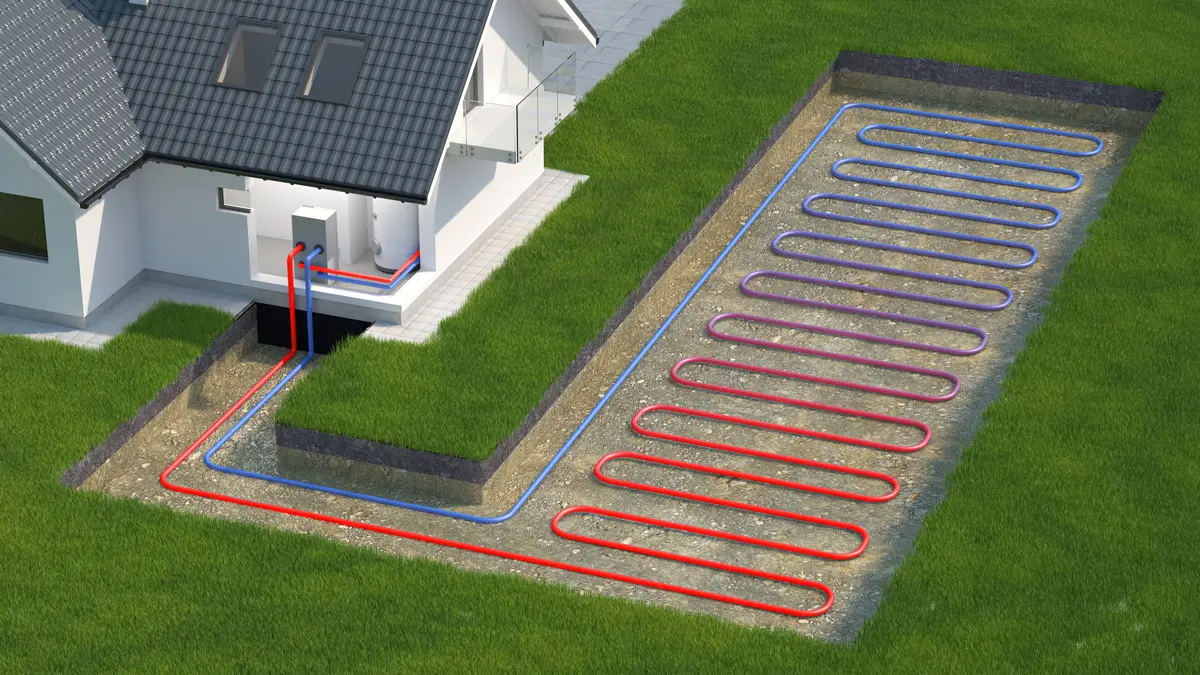
This is definitely the most ‘magical’ solution. It utilises the constant temperature of the ground (which stays cool even during a heatwave) to cool the house.
- The principle: Geocooling. A fluid cooled by the earth (glycol water) is circulated directly to a heat exchanger that cools the water in your heating pipes.
- How does it work? The cool air is distributed through the floor or ceiling. It’s a very gentle cooling sensation, like in an old church, with no cold draughts on the back of your neck.
- The sustainability aspect: It uses almost no energy (just a tiny pump) and doesn’t expel hot air outside.
- Budget: It’s a substantial investment (€15,000 to €25,000), but it’s the most sustainable system available.
Can a geothermal heat pump work for city homes?
Geothermal energy can be an excellent option for more sustainable heating in the city, provided you have the required budget and sufficient outdoor space.
The ground-coupled heat exchanger
The ground-coupled heat exchanger is common sense taken to the extreme. Unlike a geothermal heat pump, which uses a fluid to cool surfaces, the ground source heat exchanger is a mechanical and passive solution.
- The principle: Outside air passes through pipes buried about 2 metres deep, before entering the house. At this depth, the ground stays at around 12–14°C even in summer.
- The technical difference: It is a ventilation system. The air is cooled simply by coming into contact with the cold pipe. It is then blown into the house, often via a dual-flow mechanical ventilation system.
- Advantages: Simple, robust and offers exceptional air quality. It’s also ideal in winter: it preheats the freezing outside air before it enters your home, thereby reducing your energy bills.
- Budget: Expect to pay between €3,000 and €6,000 for digging the ground and installing the system.
Air-to-air heat pumps
This is the easiest system to install.
- The principle: Unlike a ground-coupled heat exchanger, the air-to-air heat pump cools the air which is already in the room. It acts very quickly: you switch it on, and ten minutes later, the temperature is lower.
- The sustainability aspect: To make it ‘green’, you need to choose a highly energy-efficient model (A+++) and, if you have solar panels, run it when they are generating at full capacity.
- Advantages: Unbeatable for cooling a specific room very quickly. It’s a 2-in-1 system, acting as a highly energy-efficient heater in winter.
- Budget: From €2,500 (for one room) to over €10,000 (for the whole house).
Which option to choose?
It all depends on your starting point. The first step is insulation. If your windows or roof let all the heat through, running any machine will be futile. This is step 1 for a healthy home.
Next, it’s a question of your property, preferences and budget:
- Do you have a garden and want the very best? Opt for geocooling. It’s quiet, eco-friendly and extremely comfortable.
- Do you want constantly cool air without air conditioning? A ground-coupled heat exchanger is the perfect solution for you.
- Do you live in the city and want instant cooling? An air-to-air heat pump is the quickest solution. It’s particularly useful if you have solar panels, to offset the running costs during heatwaves.

Summary of the solutions
| Solution | Electricity consumption | The little "extra" |
|---|---|---|
| Insulation & green roof | Zero | Also protects against the cold in winter |
| Geothermal heat pump | Negligible (pump) | The ultimate in comfort |
| Ground-coupled heat exchanger | Very low (ventilation) | Always pure and fresh air |
| Air-to-air heat pump | Moderate | Ultra-fast cooling |
All these solutions have one thing in common: they are far more environmentally-friendly than older systems. They allow us to stay cool without adding more heat outside.