
Many of us are looking for more sustainable heating solutions. Carbon-neutral and easy to use, pellet stoves have numerous advantages. Should we all adopt this type of stove? Weigh the pros and cons and find out if it's worth it.
Pros of a pellet stove
Ideal as supplementary heating
A pellet stove is useful as additional heating during the mid-season. You can lower the central heating slightly at the start of winter and turn it off earlier at the end. When it’s extra cold, the pellet stove can support your central heating.
Easy to use
Forget paper, kindling or matches. A pellet stove runs on electricity and has automatic ignition and a thermostat. Simply press the on/off button or set a timer. The latest models are programmable and can be controlled via a remote or your smartphone.
Excellent efficiency
A stove using high-quality pellets achieves an efficiency of 85 to 95%. In the most efficient systems, only 5% of the energy is lost through the flue. That’s far better than traditional systems:
- Open fireplace: 10 to 15%.
- Wood insert/cassette: 70 to 80%.
- Classic wood stove: 70 to 85%.
Simple flue system
Pellet stoves don’t need a chimney with strong draught: smoke is expelled by forced ventilation through a pipe of 80 to 120 mm, vertical or horizontal, even with a bend. You can install the stove almost anywhere: against an outside wall, near a socket or under a ceiling.
The stove uses either room air or outside air for models with a double pipe or separate air intake.
Low fine particle emissions
Pellet stoves emit very few fine particles compared to other stoves or an open fireplace.
| Average emissions per GJ (PM10 g/GJ): | |
|---|---|
| Open fireplace | 820 g/GJ |
| Pellet stove before 2000 | 740 g/GJ |
| Pellet stove 2000–2014 | 370 g/GJ |
| Wood stove after 2014 | 93 g/GJ |
| Accumulation stove after 2014 | 93 g/GJ |
| Pellet stove | 60 g/GJ |
| Central heating oil | 1,5 g/GJ |
| Central heating gas | 0,2 g/GJ |
Actual emissions depend on the appliance type and age, fuel quality, combustion conditions and ventilation. Modern pellet stoves emit as little as 8 g/GJ.
Neutral carbon footprint
Pellets are made from sawdust from the wood industry (furniture, joinery…). Pellet stoves have a neutral CO₂ footprint: the carbon released during combustion equals the amount absorbed by the tree during growth.
- Quality pellets comply with environmental standards (DINplus, ENplus®).
- In Belgium, they must meet specific requirements (no chemicals, calorific value…) set by Royal Decree.
Non-certified pellets produce less heat and dirty the appliance (more ash, dust…). They don’t come from sustainably managed forests (PEFC, FSC labels).
Cons of a pellet stove
Less charm
The flame effect of a pellet stove doesn’t match the charm of a wood stove, except for models with natural convection.
Heavy, bulky bags
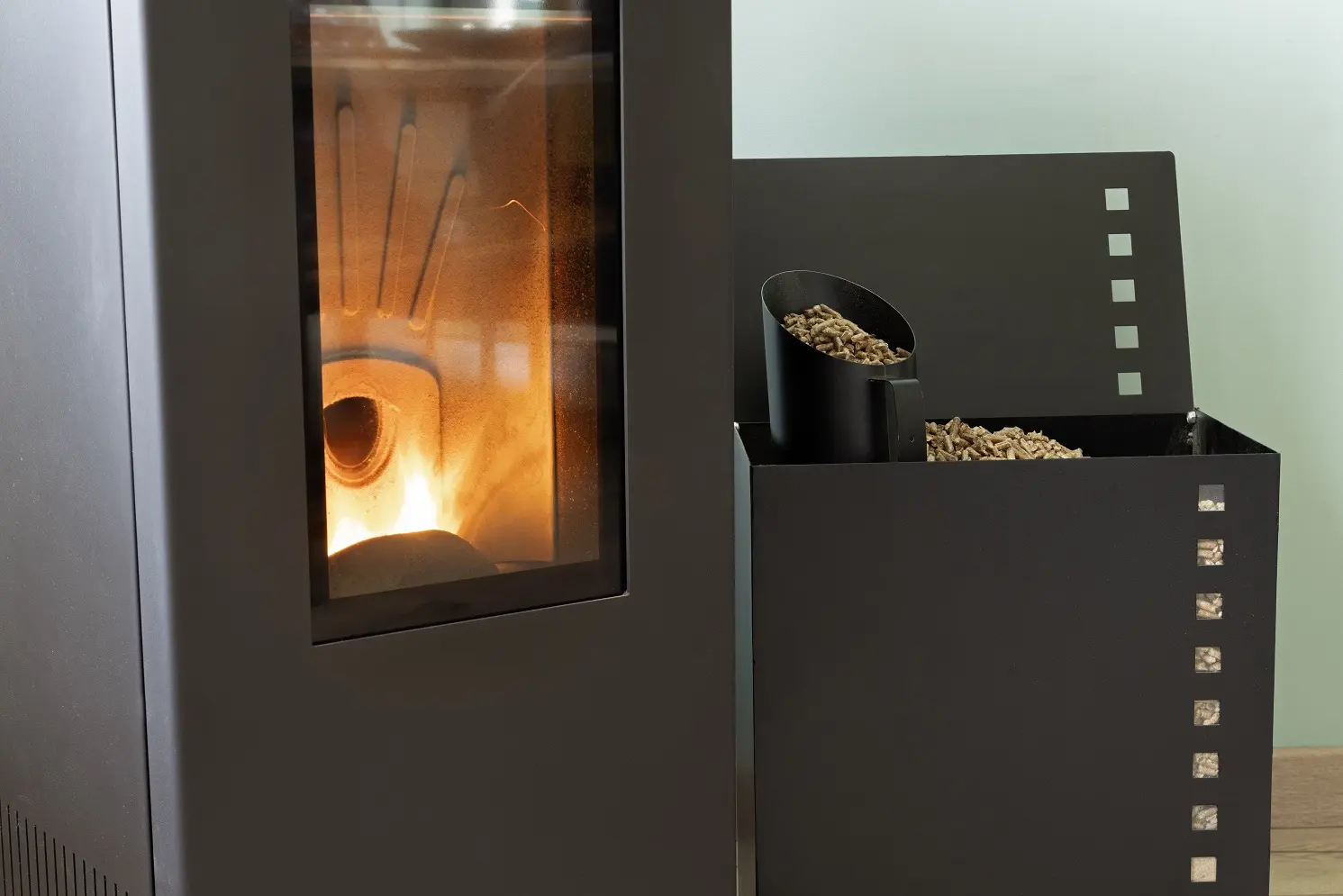
A bag of pellets weighs 10 to 15 kg. A stove uses 1.5 to 4 bags per day. Not always easy to carry, especially if you live upstairs. You also need dry storage space.
Consumption impact
Usage depends on the size and insulation of the room, as well as heating time and desired temperature. The built-in hopper lasts about 12 hours at full power and 36 hours at one-third power.
Requires electricity
Automatic ignition, the feed screw, ventilation and electronic controls all need power.
Regular maintenance
A pellet stove must be properly maintained for optimal performance:
- Every 2 days: clean the burner with a brush.
- Every 2 days to 2 weeks: empty the ash pan.
- Every 2 weeks: clean the heat exchanger.
- Annually: full service by a professional (access to flue, moving the stove).
Noise issues
A “quiet” appliance produces less than 32 dB (quieter than a fridge). A cheap model reaches 49 dB, unpleasant in a living room.
Noise comes from:
- the feed screw, which runs continuously (almost silent) or intermittently;
- the fan, very noisy at start-up.
Powerful units are louder. Modern, high-end stoves have a silent mode or significantly reduce these sounds.
Installation costs
Pellet stoves can be a good supplementary heating option, but their cost is considerable. The budget for the appliance and its installation generally ranges from a few thousand euros for entry-level models to over €10.000 for high-end configurations and equipment.
This makes them a particularly relevant choice in certain specific situations, for example, in regions where wood is readily available. But beyond the financial aspect, it's also a personal choice for more sustainable heating.
How to choose?
Now that you know the pros and cons of a pellet stove, choosing should be easier. Do you still have questions? Discover which model best suits your home and at what price.
What type of pellet stove should I choose?
Discover the different models, their features and prices to find the ideal pellet stove for your home.