
Your home’s electrical capacity determines how many appliances you can use at once without the power tripping. In many cases, the standard supply is enough, but with electric cars, heat pumps, and other high-power devices, this isn’t always the case anymore.
Power: your electrical 'flow rate'
The power of your meter is always expressed in kVA (kilovolt-amperes). This is the total capacity that your grid operator provides to you. In Brussels, for example, most meters supply a power of 9.2 kVA.
This value determines the limit of your meter: if the total simultaneous power of your appliances (the 'peak power') exceeds your available kVA, your circuit breaker will cut off the power.
Why kVA and not kW?
Your total available power is expressed in kVA, but your appliances are labelled in kW. Strange, isn't it? In fact, kVA represents the total current flowing through your installation. This includes active energy (kW) but also reactive energy, which is needed, for example, to create the magnetic fields of motors.
But don't worry: in a standard home, it is often assumed that 1 kVA = 1 kW, because the 'power factor' is close to 1 (domestic installations consume little 'reactive' energy).
Is your power sufficient?
In many homes in Brussels, the meter capacity is 9.2 kVA. This means that you can use a total of approximately 9,200 watts at any one time.
In practice, the power required does not depend on a specific appliance, but rather on the peak power. This is the maximum consumption you reach when several energy-intensive appliances are running at the same time.
It does not matter if your oven is very energy efficient if your washing machine and heating are already running at full power when you turn on your oven. It is this simultaneous peak accumulation that determines the actual power requirement of your installation.
An example
Suppose your heat pump is running (3 kW), your hob is on (5 kW) and, at the same time, several appliances are being charged (1 kW). Together, this quickly adds up to 9 kW. If your meter capacity is around 9.2 kVA, the circuit breaker may trip to protect your installation.
What is your peak power?
Normally, you rarely use all your appliances at the same time. Your installed capacity (e.g. 9.2 kVA) is therefore higher than what you usually need. The peak power that many families require at a busy time averages around 5 to 6 kVA.
Do you use several heavy appliances at the same time, such as charging station, a heat pump or an electric storage water heater? Then that power may be insufficient. In that case, try to spread your consumption as much as possible, for example by using a load balancing system.
Examples of power
Here are some examples of the power consumption of common appliances.
| Appliance | Power |
|---|---|
| Charging station | 3.7 kW to 11 kW |
| Heat pump | 2 to 6 kW |
| Electric storage water heater | 2 to 3 kW |
| Drying cabinet | 2 to 3 kW |
| Sauna (electric) | 4 to 9 kW |
Did you know?
Most electrical appliances operate at a 'cruise' power (nominal power), but sometimes they need to be supplied with much higher power for a very short period of time. Let's take a refrigerator as an example:
- Nominal power: when operating normally to maintain the cold, it consumes approximately 150 watts.
- Peak power: when the compressor starts up, it may require 450 to 600 watts for a fraction of a second to overcome the inertia of the motor.
Curious about your consumption peak? With code 1.6.0 on your smart meter, you can immediately see your highest peak of the month. Check it out for yourself!
What is the capacity of my installation?
These are the most common cases:
- Single-phase 230 V (most homes): 9.2 kVA.
- Three-phase 230 V with a 32 A circuit breaker: 12.7 kVA.
- Three-phase 400 V + N with a 25 A circuit breaker: 17.3 kVA.
Good to know: if you live in Brussels, you can easily find your meter details online.
Can I change the power rating?
If you want to increase the electrical power of your installation, it is best to first ask your electrician for advice. They will assess which solution is most suitable for your situation.
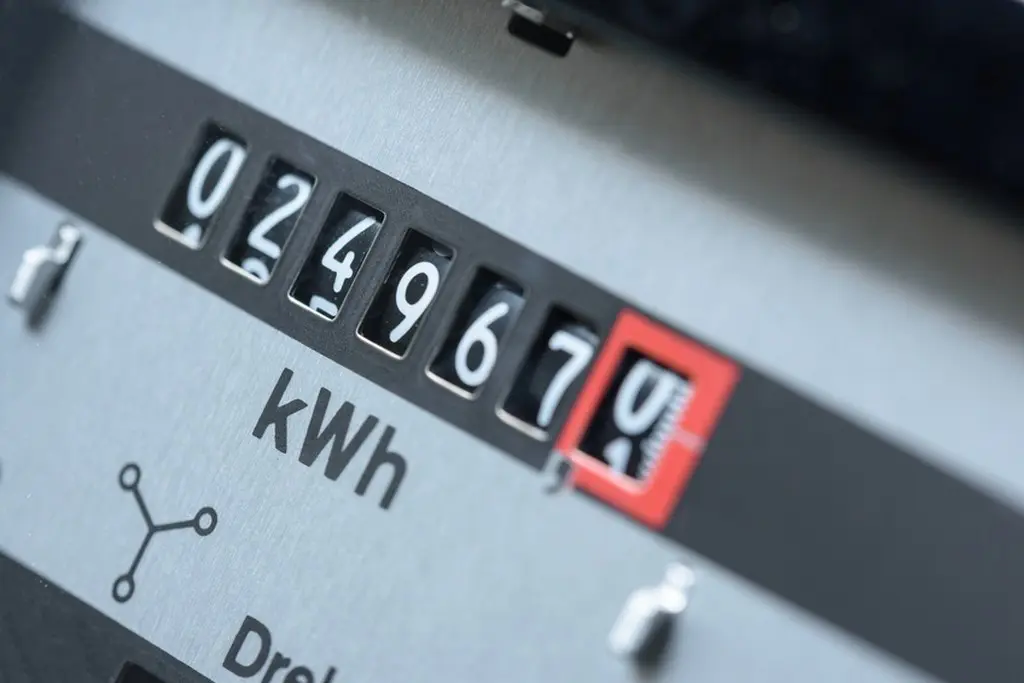
Single-phase or three-phase: what’s the difference?
You don't need to be an expert to find out. You can tell by the wires or the small symbols on the meter.
There are 2 options:
- Stay single-phase and increase the meter capacity.
- Switch to three-phase and possibly increase the power.
For these changes, please contact your electricity distribution network operator. They are responsible for the connection, regardless of your energy supplier. Do you live in Brussels? Then contact Sibelga.
The installation costs will be invoiced once and will not affect your monthly energy bill.