
Imagine for a moment: it is 2045. In the middle of the plains, immense circular structures hum in silence. They produce nothing, they manufacture nothing. They do the opposite: they suck in the air, filter it, and release a breeze purified of its excess carbon. These "planetary air conditioners" are powered by nuclear fusion, a near-infinite energy source that reproduces the energy of the stars on Earth.
Science fiction? Not quite!
While we struggle today to reduce our emissions, an invisible enemy awaits us around the corner: thermal inertia. Even if we stopped all pollution tomorrow, the oceans, like a giant radiator, would continue to warm the atmosphere for the next 50 years.
Faced with this "already paid-for warming", reduction of emissions alone is no longer enough. We are also going to have to repair. But can we really adjust the Earth's thermostat without breaking everything? And above all, why is nuclear fusion the key capable of opening this door?
Let’s dive behind into the vision of a crazy, but perhaps the most necessary project for the 21st century.
Planetary "air conditioners"
An intuitive idea comes to mind: if the planet is overheating, why not install huge air conditioning units to release cool air into our cities and countryside?
This solution is seductive, but you cannot simply install an AC unit as you would on a window. In fact, an AC does not "produce" cold; it evacuates heat to the outside. But on a planetary scale, where is "the outside"? The Earth's atmosphere is a closed system. Installing giant air conditioners would do nothing more than stir the air.
The only real evacuation possible for this heat would be to send it directly into the vacuum of space. However, building infrastructure capable of physically "pumping" hot air into space would represent a colossal and likely ineffective engineering challenge.
The real solution: carbon capture
Fortunately, there is an alternative. To regulate the global thermostat, we shouldn't try to move the heat, but rather restore the Earth's ability to cool itself.
Instead of "moving" hot air, we could "filter" the air to rid it of its. CO2 acts as a layer of "planetary insulation" that prevents heat from escaping. By clearing the atmosphere of its CO2 to return to pre-industrial levels, the heat would once again have a "natural exit door" to space.
So, there is no need to create huge "exhaust tubes" to space or send rockets loaded with CO2 up there. Instead of tackling the symptoms (the heat), we remove the "blanket" (greenhouse gases) that traps that heat.
It’s a "reverse greenhouse effect": by removing massive amounts of CO2, we make the atmosphere much more "transparent" to infrared rays. The Earth would evacuate its heat to space far more efficiently.
Fusion: the fuel for the clean-up
So, all that's left is to build these giant "air filters" and press "ON"? Unfortunately, it’s not that simple. Direct Air Capture (DAC) of carbon requires a colossal amount of energy.
Today, the cost of direct air capture is prohibitive because electricity is expensive (roughly €500 € to €900 per tonne). With solar, wind, or even current nuclear fission, it is too expensive and too slow. This is where nuclear fusion comes in.
With nuclear fusion, the marginal cost of energy tends towards zero. A single glass of fusion fuel produces as much energy as 1,000 tonnes of coal, without any CO2. We could then envisage removing not millions, but gigatonnes of carbon, finally reversing the temperature curve despite the thermal inertia of the oceans.
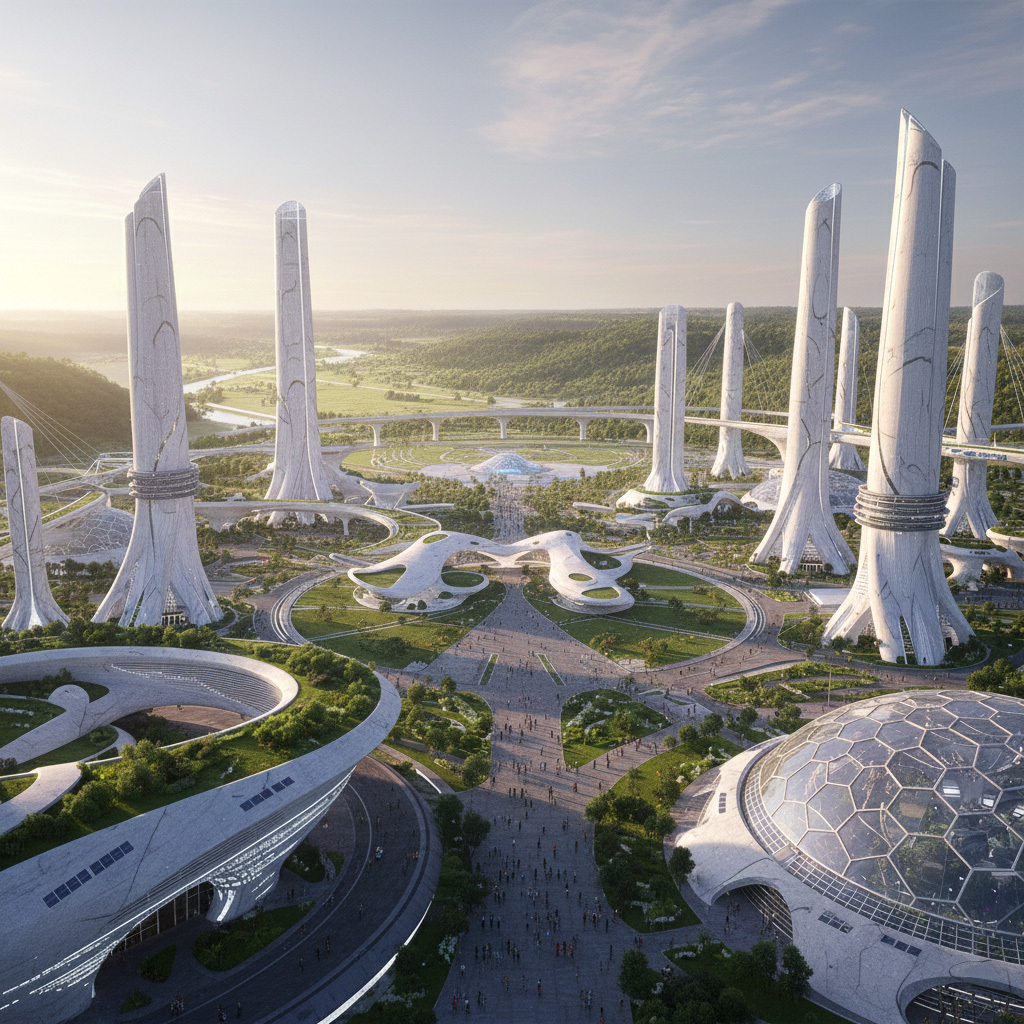
2045 : The Climate Restoration Centre. At the heart of this infrastructure is a fusion reactor (central dome), providing the colossal energy needed to power the "planetary air conditioners" (the circular structures). Conceptual illustration generated by AI, 2026.
A paradigm shift
A saying exists in scientific circles: "Fusion is the energy of the future, and it always will be". We have been researching nuclear fusion for decades, and the technical challenges are immense.
But today, things are moving. For the first time in 70 years, we are no longer just talking about fundamental research, but about engineering. Projects like ITER (in France) are planning the first large-scale tests as early as 2034, with the construction of the first reactor capable of injecting electricity into the grid starting from 2050.
For the past 10 years, private companies (Commonwealth Fusion Systems, Helion, Tokamak Energy) have also been shaking up the schedule by using technologies that ITER's designers didn't have at the time.
- High-Temperature Superconducting (HTS) magnets: These allow for the creation of much smaller and cheaper reactors, while being more powerful.
- Artificial Intelligence: Nuclear fusion is a reaction so unstable that it requires millions of adjustments per second. Only AI can meet this colossal computing challenge by stabilising the plasma in real time.
Microsoft's Bet
In 2023, Microsoft signed an agreement with Helion Energy to buy electricity from fusion as early as 2028. It’s an extremely ambitious (even risky) timetable, but it shows that the private sector believes an imminent breakthrough is possible.
A global project for the climate
You might be thinking: "That’s all well and good, but in the meantime, the planet keeps warming up!". If we follow the classic path, fusion will indeed not be a solution before 2050.
The problem with "going faster" is no longer just the science; it’s the fragmentation of efforts. The ITER project in France is a feat, but it remains a research tool slowed down by complex diplomacy and national imperatives.
If the whole world decided to transform nuclear fusion into a true "Global Project of the 21st Century", we would unite the strike force of states with the audacity of the private sector. By removing all barriers, fusion could become a global commercial reality in less than 10 years.
Comparison of trajectories towards global "air conditioning"
| Level of effort | Estimated horizon | Mindset and means |
|---|---|---|
| The classic path | 2050 - 2060 | Research and diplomacy: a schedule constrained by national interests. |
| The Global Project | 2035 - 2045 | Absolute human priority: union of public and private sectors, open patents, and technological acceleration (AI, new magnets). |
With 15 years gained, we could deploy this massive carbon capture infrastructure just in time to prevent entire regions from becoming uninhabitable.
What if future fusion reactors were no longer evaluated on their electricity production, but on their capacity to capture carbon?
Vision for a Global Climate Restoration Project
What to do with all that CO2?
Once the carbon is captured, we’ll have to do something with it. If it’s just to produce "extra waste", we would only be moving the problem. In fact, the carbon would not be "stored in barrels" and "buried in the ground for millennia" waiting for it to degrade.
Once pure CO2 is captured, 2 paths open up to us thanks to fusion energy:
- Mineralisation: CO2 is injected into underground basaltic rock formations where it turns into stone within a few years. This is the safest form of storage.
- Fuel: Energy is used to transform CO2 into neutral synthetic fuels (e-fuels) for sectors that are difficult to decarbonise (aviation), or into construction materials (solid carbon).
Iceland: an ideal laboratory
Iceland is today one of the world's leading laboratories for this "transformation into stone" technique. The island also has another asset: through its natural coolness and geothermal energy, it is the ideal host for AI supercomputers. These "brains" are indispensable for simulating plasma behaviour, a crucial step in training the AIs that will pilot our fusion reactors tomorrow.
Pyramids of rubble?
When we talk about "solid storage", you immediately imagine pyramids of rubble covering the continents. The answer is fascinating: No, because the Earth is already, for the most part, a huge ball of gas transformed into stone.
We are not creating "new" matter. The carbon we extract from the air in the form of CO2 originally comes from the subsoil (coal, oil, gas). By turning it into stone, we are simply putting it back where it came from, but in a stable and inert form. It is not a cumbersome "waste"; it is a return to geological equilibrium.
The Earth has 130 million square kilometres of land and even more under the oceans. By embarking on a major clean-up project spanning the rest of the century (75 years) to return to a "pre-industrial" level (pre-1850), we reach a total thickness of about 4 millimetres below the surface, or about two stacked 2-euro coins.
It’s a titanic project because of the energy it requires (fusion), but minuscule because of the space it takes up. Repairing two centuries of industrial pollution physically amounts to adding a 4-millimetre layer of stone deep in our subsoil. This is the almost invisible price of our return to equilibrium. But we can do even better.
What if tomorrow, our cities were built with the polluted air of the past?
Vision for circular urban planning
The future of construction
What if, instead of "stupidly" injecting mineralised carbon into the subsoil, we used it for construction? This is the question driving many engineers interested in the circular economy. The idea is attractive: rather than simply "hiding" carbon under our feet, we could make it the raw material for the cities of the future!
Today, the building industry is one of the most polluting in the world (due to cement). These stones could replace gravel in concrete. The carbon would thus be "trapped" in the walls of our houses, our bridges, and our roads.
Amusing coincidence: the construction sector consumes about 50 billion tonnes of sand and gravel per year. That is almost exactly the volume of CO2 we emit! If we transformed all our annual CO2 into construction gravel, we could cover the entirety of the world's needs for building aggregates.
Tomorrow, our skyscrapers may no longer be sources of pollution, but "solid carbon blocks". Thanks to fusion, we could literally build our towns and villages with the polluted air of the past.
The priority: stabilising the patient
Nuclear fusion could offer us the climate "reset button" we will need to mop up the past. But for this button to work one day, we must first stabilise the patient today with the tools at our disposal: sobriety and renewable energy.
Imagine a sinking boat. If we stop plugging the holes (our current efforts) on the pretext that we are going to install a giant pump in 15 years, the boat will have sunk long before the pump is plugged in.
Capture technology has limits. It cannot catch up with everything. If we wait too long, certain systems (like the melting of Greenland or the release of Siberian methane) will spiral out of control on their own. At that stage, even with 1,000 fusion reactors, we will no longer be able to stop the machine.
Our current efforts serve to prevent the task of the "global air conditioners" from becoming impossible. The less we emit today, the more effective fusion will be in saving us tomorrow. Fusion is not an alternative to renewable energy, but the indispensable complement to offer a sustainable future to future generations.