
It's very recognisable: as soon as the temperature hits 25°C, our homes trap the heat like bricks in an oven. Rather than rushing out to buy the first air conditioner you find, you can try a few simple solutions to bring the temperature down without breaking the bank.
Keep the heat out
The principle is the same as in winter: to stop the cold from getting in, your walls, roof and windows need to be as airtight as possible. Insulation is therefore your go-to reflex and the best investment.
You obviously can’t magically insulate your entire house when a heatwave strikes. Pending your major insulation works, the following are a few simple habits to adopt:
- Keep windows closed during the hottest part of the day: Close the windows as soon as the outside air is warmer than the inside air. In Belgium, we often have the reflex to ‘air the house’, but at 30°C, you’re only inviting the heat in.
- Eliminate sources of heat: Don’t use the oven to cook; prepare cold dishes instead. Unplug any appliances that generate heat, such as computers or halogen lamps.
- Relocate certain electrical appliances: Fridges and freezers heat up the room they’re in. If possible, move them to an outhouse.
Did you know?
The roof is often the primary source of heat. If you have bedrooms in the attic, roof insulation is your top priority. Without it, the roof tiles can reach 80°C and radiate heat like a grill right above your bed.
Protecting yourself from the sun
You also need to protect yourself from the sun’s rays. A south-facing window without protection is the equivalent of a 500-watt radiator left on constantly in your living room. Multiply that by how many windows your home has, and you’ll understand why it overheats.
- Close the shutters: As soon as the sun is shining, close everything! External shutters are your best allies as they block the rays before they hit the glass.
- Draw the curtains: If you don’t have shutters, close your curtains. Choose light-coloured ones. They will reflect light and heat rather than absorbing it. This is less effective than external protection, but it limits the ‘overheating’ of furniture and floors.
- Fit protective films to your windows: These will filter out UV rays and reduce the effect of the sun in living areas, while still letting light through.

Let the cool air in
Good air circulation is also essential. Residents of cities in southern regions set a good example: they keep all their windows closed during the day and open at night to cool down the overheated walls.
This is the principle of night cooling or free cooling, which these days is applied in the ventilation systems of large office buildings.
- Open everything wide as soon as the sun goes down: The heavy materials in your home will absorb this night-time coolness and release it slowly over the following day. It’s your natural cooling system.
- Night-time tip: Place a fan in front of an open window in the evening, pointing towards the inside of the room, to force the cool air from outside in more quickly.
Create a draught
A fan doesn’t cool the air; it cools your skin. By evaporating sweat, it gives an immediate sensation of coolness.
- Use a conventional fan: Simple and effective. To boost its effect, place a damp towel or a bottle of ice-cold water right in front of it. The circulating air will pick up the cool moisture, creating a mini comfort zone.
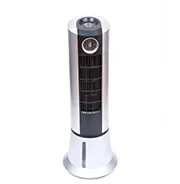
- Use an air cooler: Also known as an adiabatic cooler, it draws in hot air, passes it through a damp filter and returns the cooled air to the room. It works on the same principle as an ‘upgraded fan’. The water tank can often be filled with ice cubes.
- Use a patio atomiser: These little nozzles that spray micro-droplets are a real treat on warm evenings when you do a barbecue. The water evaporates instantly into the air, absorbing heat along with it.

As a last resort: portable air conditioner
Sometimes, when the heatwave drags on and the outside temperature doesn’t drop enough at night, a portable air conditioner is the only way you can sleep.
- Bear in mind: Its main drawback is the exhaust pipe. If you run it through a half-open window, you’ll let in as much heat as you expel! Use a window sealing kit.
- The cost of cool air: Air conditioners are noisy appliances that use a lot of electricity. Even if you have solar panels, don’t think of them as ‘free energy’. They are a last resort rather than a miracle solution.
Did you know?
A portable air conditioner can consume up to 50 or 100 times more energy than a simple fan. That's a colossal electricity bill for comfort that is often limited due to hot air seeping in through the exhaust pipe. It really is a solution to be used only when all other tips have failed.
And for next summer?
If you find yourself out of breath with an air conditioning pipe sticking out of the window, it’s a sign that it’s time to plan ahead.
To avoid relying on these energy-guzzling solutions, consider passive protection (blinds, insulation) or integrated cooling systems such as ground-coupled heat exchangers or heat pumps.
These techniques, which are far more sustainable and quiet, keep your home cool without the need to set up a window exhaust every year.