The packaging of a new light bulb always displays an energy label. The label shows at a glance how economical and efficient the light bulb is. But what exactly does the label say?
The European Union originally introduced the energy label for household appliances such as fridges and washing machines. These days, you see the label in more and more sectors: on light bulbs, TVs, buildings (EPB certificate), cars and more.
The intention is clear: to help you make energy-efficient choices. These choices not only reduce your energy bill but also your CO₂ emissions. By choosing efficient products, you as a citizen actively contribute to the energy transition, without compromising on comfort at home or at work.
Energy classes
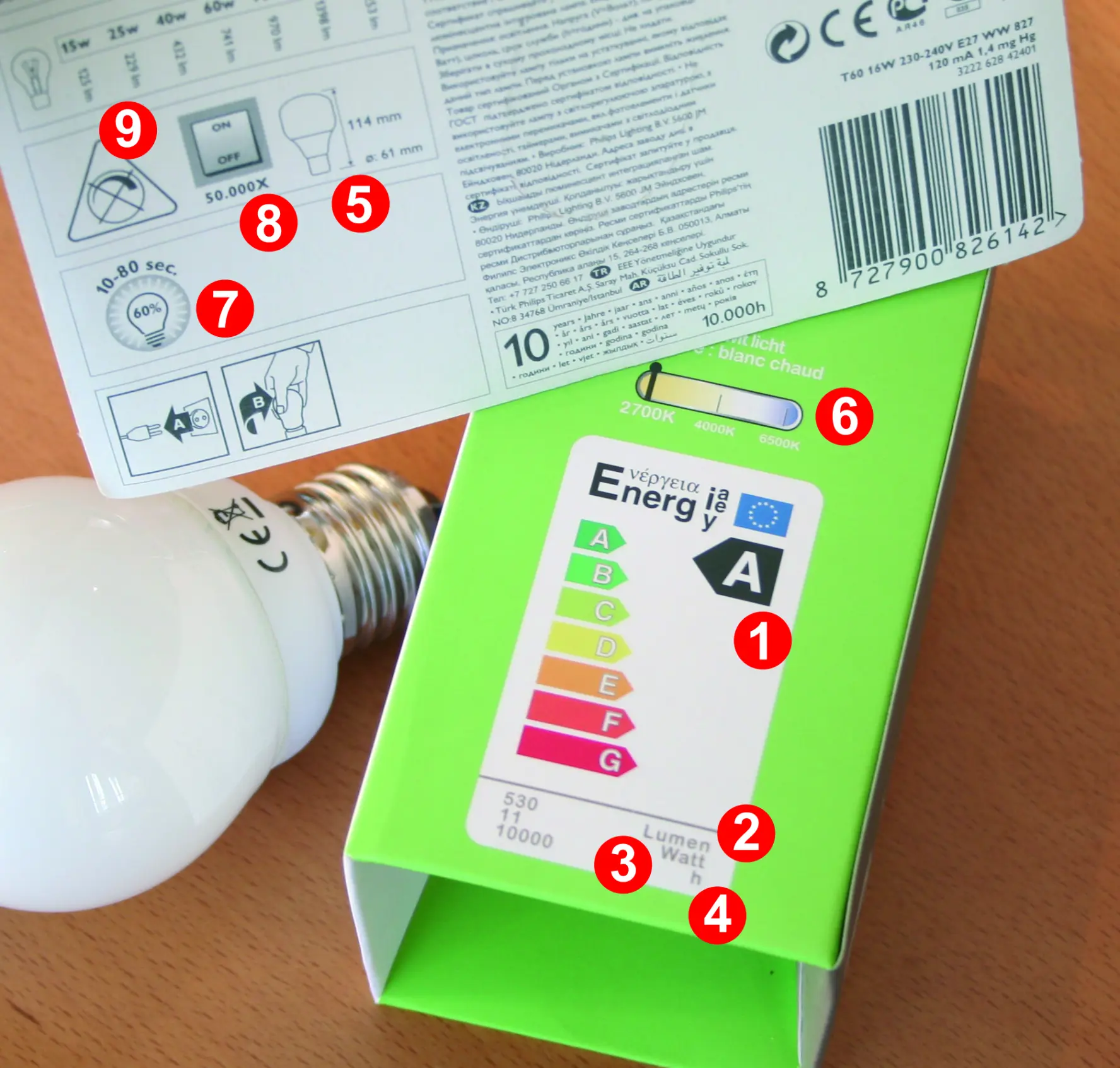
Thanks to the large letter and coloured bars, the most noticeable thing is the lamp’s energy class (1). The best lamps are in class A, the least efficient in class G.
Some LED bulbs achieve energy class A because of their high efficiency in lumens per watt (lm/W): they therefore provide a lot of light using very little electricity.
| Class | Efficiency (lm/W) | Typical examples |
|---|---|---|
| A | > 210 | The future: High-end LED bulbs (very few models currently available). |
| B | 185 to 210 | The current leader: New generation of LED bulbs. |
| C | 160 to 185 | Outstanding LED: Modern, high-performance LED bulbs. |
| D | 135 to 160 | Good LED: High-quality LED tubes or high-performance standard LED lamps. |
| E | 110 to 135 | Standard LED: The majority of LED bulbs from quality brands. |
| F | 85 to 110 | Entry-level models: Conventional LED bulbs and some energy-saving bulbs (compact fluorescent lamps). |
| G | < 85 | Energy-intensive: Obsolete halogen bulbs (still in stock) or less efficient decorative LED filament bulbs. |
Don’t get fixated on Class A: Class A is still rare and expensive in 2026. A product with a D or E label is still very energy-efficient LED technology compared to obsolete incandescent bulbs.
Stricter classification
Since 2021, the European Union has used a revised energy label, whereby the classification is now stricter than before. The previous classification had become too crowded: almost all LEDs had an A++ label, making it impossible to differentiate between them. These days, a bulb that was previously classified as A++ may now be in class D, E or even F, even though it has exactly the same energy consumption.
Units and lifespan
Just below the energy class, you will see 3 figures with corresponding units:
- Luminous flux (2): Indicates how much light the bulb emits, expressed in lumens (lm). The higher this figure, the more light you get for the same energy consumption. So don’t look at watts anymore, but at lumens.
- Power (3): Indicates consumption, expressed in watts (W). The higher the power, the more electricity the bulb uses. For example, a 13 W bulb consumes 0.013 kWh per hour.
- Lifespan (4): The expected service life of the bulb, expressed in hours (h). For reference: a bulb is used for an average of 1,000 hours per year.
Other information
Besides the energy label, the packaging contains other information to help you choose the right bulb:
- Dimensions (5): The size of the bulb, including the base and diameter, in millimetres (mm). That way, you know the bulb will fit in your light fitting.
- Colour temperature (6): The colour of the light, in kelvin (K).
- Less than 4,000 K indicates warm, cosy light (ideal for living areas).
- More than 5,300 K indicates cold light (suitable for workspaces or garages). - Warm-up time (7): The time the bulb takes to reach 60% of its light output, in seconds (s).
- Number of switching cycles (8): How often you can switch the bulb on and off without any loss of quality.
- Dimmable (9): Whether you can use the bulb with a dimmer. Handy for adjusting your lighting to suit any moment: from focused work to relaxing on the sofa.
Environmental criteria
The energy label tells you how energy-efficient a bulb is, but says nothing about its total environmental impact. If you also want to take this into account, check whether the bulb has the European Ecolabel (blue with a green flower and star-shaped petals).
This European label guarantees that the product has a lower environmental impact, is safe to use and performs reliably. Please note: the eco-label is voluntary. A bulb without this label may therefore be just as environmentally-friendly or even score better. Nevertheless, it is still a useful guide if you want to ensure more conscious consumption.
Which LED bulb is the best replacement for my old bulb?
Switching to LEDs is now a no-brainer! But what wattage should you choose? And what ambiance are you looking for? Find out how to find the perfect match for your old bulbs.