
Producing your own electricity is already a major step forwards, but knowing how to store it is the true key to success, as that means that you are no longer dependent on the sunlight or wind available at that moment in time. Now that our use of renewable energy sources is increasing, storing that energy has become the missing link that will completely change the way we consume energy.
On a technical level, you cannot store energy as soon as you generate it. It first needs to be converted into a different form. This is achieved by means of a transformation cycle that converts the flow of electrons into chemical, mechanical or thermal energy. Only when you actually need the electricity, is it then released again.
Each storage method has its own unique properties and three main factors are then crucial in that regard:
- Its efficiency: the ratio between the energy stored and the energy recovered.
- Its energy density: the amount of energy you can store per volume or weight.
- The discharge time: how fast or how slowly the energy is made available again.
At a glance
Here is a brief summary of the various storage methods. Click on a technology to go directly to the detailed explanation:
| Chemically | Mechanically | With movement | As heat |
|---|---|---|---|
Tip: This article provides an overview of all the available technologies. Are you mainly looking for specific ideas for your home? If so, skip straight to our practical summary at the bottom.
Chemically
Using a battery
A battery works on the basis of a ‘reversible’ chemical reaction. This means that the reaction can take place in two directions:
- In one direction, electricity is converted into chemical energy and stored.
- In the other direction, that chemical energy is converted back into electrical current.
Lithium-ion batteries are the most efficient and most frequently used technologies nowadays for a great many applications, such as in home batteries linked to solar panels. Other types of battery also exist, however:
- Lead batteries: The traditional, less costly technology for stationary storage.
- Flow batteries: Large installations in which energy is stored in liquids. These are ideal for long-term industrial applications.
In order to make storage more powerful and more environmentally friendly, large-scale research is under way into alternatives, such as batteries that make use of salt, redox fluids or sodium-sulphur.
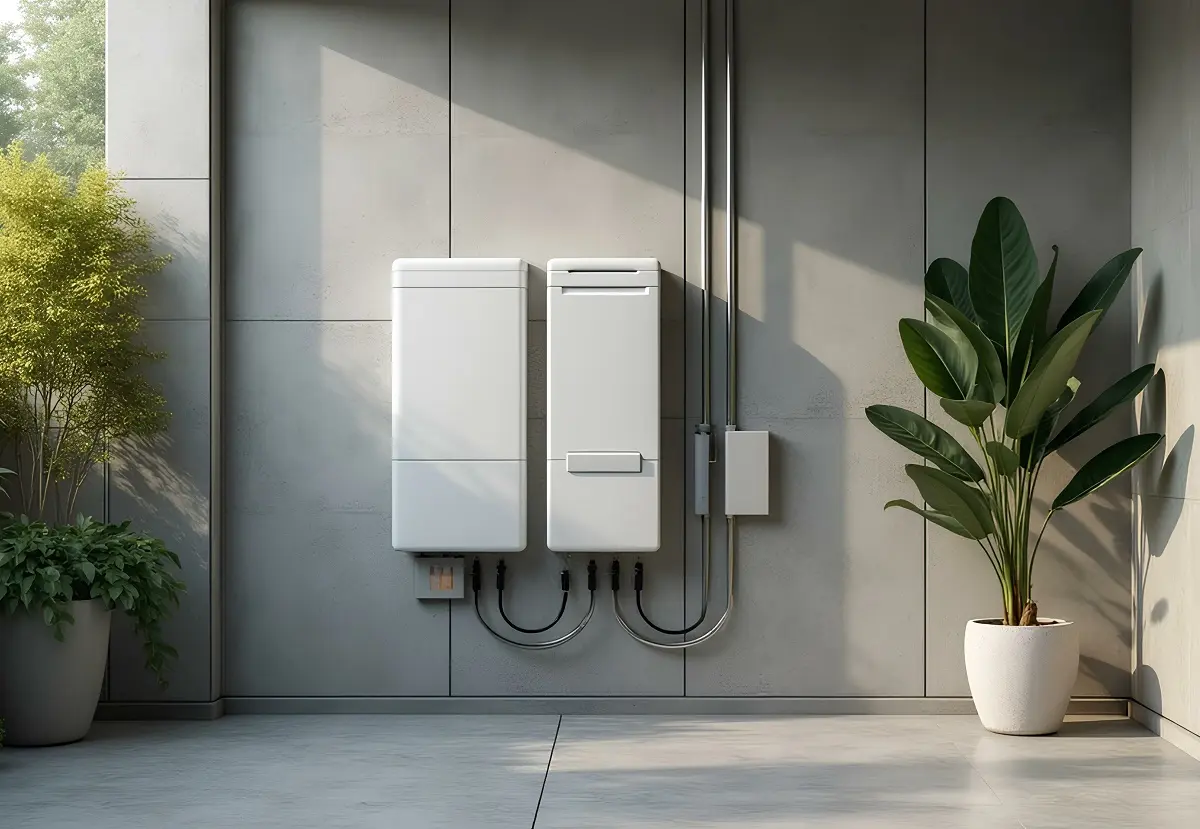
Your car as a home battery
Did you know that your electric car can also provide electricity for your home? Using Vehicle-to-Grid (V2G) technology, the battery in your car can operate in 2 directions. You charge the battery up at times when plenty of sunlight or wind is available and at times of peak consumption, your car simply returns that energy to your home or to the grid. This way, your car then becomes a smart, mobile home battery that helps you save even more.
Using a capacitor
A capacitor does not store electricity in chemical form as in a battery, but temporarily captures an electrical charge between 2 metal plates. A capacitor is the "sprinter" amongst storage technologies.
Capacitors have a number of typical characteristics:
- Lightning-fast: A capacitor can be charged and discharged extremely quickly, just like the flash on a camera that releases all of its energy in one go.
- Short-term peaks: A capacitor is an ideal way of responding to sudden peaks in the electricity network or to give electric vehicles an ultra-short "boost" during acceleration.
- Limited storage: A capacitor has only a very small storage capacity. A capacitor is able to get a machine off to a powerful start, but isn't suitable to power your home all evening long.
Using hydrogen
You can also store electricity by converting it into gas. Using surplus electricity, water is split up into oxygen and hydrogen (by means of electrolysis). The resulting hydrogen gas can then be stored under pressure in tanks, just like a giant battery.
When the energy is needed again, the hydrogen is combined with oxygen:
- In a fuel cell, the electricity is generated directly.
- In a motor, the gas drives a generator that produces the electricity.
Though this is a powerful way of storing large quantities of energy for a long period, its efficiency is still low. Too much energy is actually lost during the two-way conversion (electricity to gas and back again). As a result, this type of storage is primarily a solution for industrial use at the moment and is less suitable for powering homes.
Hydrogen from the air
Researchers from KU Leuven have even developed a solar panel that is capable of producing hydrogen directly from moisture in the air. Though the technology is looking extremely promising, it still requires further optimisation to make it economically viable.
Mechanically
Using pumps and turbines
One of the most widely used method in the world (in Belgium, it is used at the Coo power plant). In this system, water from a lake located at a lower level is pumped uphill to a reservoir situated at a higher altitude. Later on, whenever demand for electricity arises, the water flows back down again. Along the way, it drives a turbine and an alternator, which together generate electricity. This system is already used on a large scale today as a means of addressing fluctuations in renewable energy.
Using pressure accumulation
Compressed gas is stored in a sealed space with waterproof walls. Once you let the gas escape again, it drives a turbine. That turbine then drives an alternator that produces the electricity. This system is also primarily suitable for large-scale energy storage.
Using a gravity pit
Under this principle, a heavy piston is hauled upwards out of a 500-metre-deep pit using an electric motor. When that mass is released, it will fall back down to the bottom. Due to its weight, water is compressed and transported, driving an electric generator. This is how stored energy is converted into electricity.
Gravity-based storage is an interesting concept, but at the present time, it mainly takes the form of a niche solution or a demonstration project.
A train on an inclined track
This principle is rather like winding up an old-fashioned mechanical watch. A weighted train drives up a 10-kilometre long slope with a gradient of 7%. On its way down again, the weight of the train causes a generator to turn, thereby generating electricity.
With movement
With a flywheel
A flywheel is a heavy, rotating mass (a wheel or cylinder, etc.) that is brought up to speed by a motor. As it slows down, the wheel dries a generator that produces electricity.
The gyrobus
In the 1960s, electric buses operating on this principle were already in use in Belgium. Thanks to their extremely heavy flywheel, they were able to drive noiselessly and emission-free, though they often did need to stop in order to "recharge the flywheel". Despite being innovative, the system turned out to be too heavy and its autonomy too limited for modern-day urban traffic, so battery-operated buses therefore took its place.
As heat
Using a water reservoir
The most familiar way of generating energy at home is using hot water. Surplus electricity is used to heat up the water reservoir of your central heating system or boiler. By doing this, you are converting electricity directly into usable thermal energy.
Using sand
In addition to water, sand can also be used to store heat, even at very high temperatures. In Finland, for example, this technology is already being used on a fairly large scale. A 'sand battery' can store heat for months at a temperature of around 500 degrees Celsius. Surplus solar energy and wind energy generated during the summer can therefore be used to heat entire districts during the winter.
Direct use is the key
For both of these technologies, converting that heat back to electricity later on is not efficient; the amount of energy obtained is simply too low. On a practical level, this stored heat can therefore be used directly to provide heating or hot water. This is therefore a form of energy storage in the broadest sense of the word.
And for my home?
Though technologies such as sand batteries or hydrogen panels will be widely used in the future, they are not yet sufficiently well developed to be used in the cellar of your home. So what can you actually do as a private individual or as a co-owner of a property?
- A home battery: This is the most familiar route. In the evening, this is an ideal way of consuming the solar energy generated during the day, even though the cost of the investment is still considerable.
- An electric car (V2G): Do you have an electric car? If so, you may already have an enormous battery on wheels that is capable of supplying your home in the future.
- Thermal storage: The simplest and least costly method. By operating your electric boiler or heat pump in a smart way, you can store energy in the form of hot water.
Storage or smart consumption?
Despite all of the technological achievements, the most efficient form of energy is still the energy that you do not have to store. Given the current prices of batteries, storage is not actually the cheapest option in all cases.
The golden rule is still: make maximum use of energy by consuming it yourself. You can get the most out of your installation by running your dishwasher or charging point during the day while your panels are producing energy. What is more, generating your own electricity will also reduce your energy bill and you will also be helping to stabilise the grid.
Do you sometimes have a surplus? If so, you can now also take part in energy sharing. This involves selling your surplus electricity or giving it away to neighbours or other users within your condominium. Storage is a great help, but smart consumption and smart sharing are the biggest winners for your wallet!
How to make the most of my solar panels?
It’s not just about generating power, but also about consuming it smartly. Discover how to perfectly match your consumption to your own output.