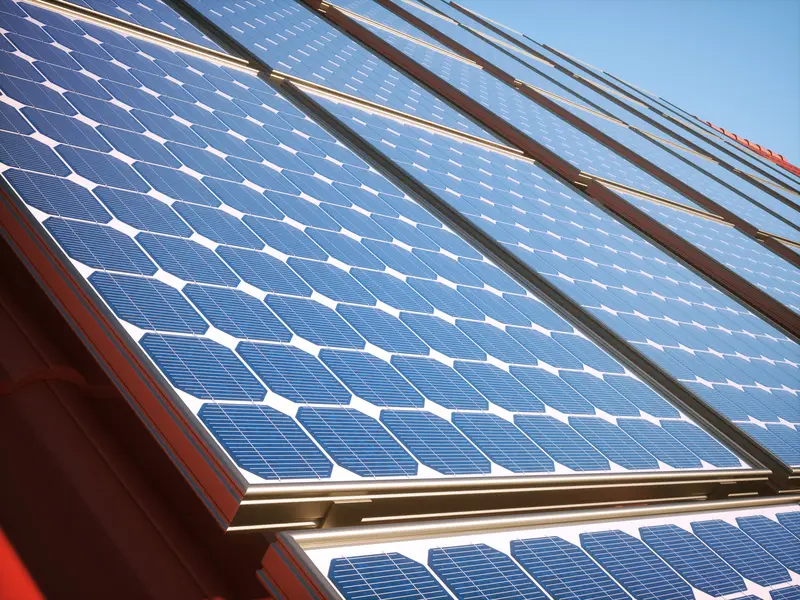
Producing your own energy is almost like magic. You install a few dark coloured panels on your roof and suddenly, your meter slows down, or even stops completely. But how does this little technological miracle actually turn a ray of sunshine into a nice hot coffee?
The solar landscape has changed dramatically over the last few years. If you've heard about the "blueish" panels (polycrystalline), be aware that these have become a rarity nowadays. Today, it's monocrystalline that dominates the vast majority of the market.
But make no mistake: Hiding behind a very similar appearance, albeit black, it's the "interior lining" of the cell that makes all the difference. We're no longer wondering whether the panels will work; now, we want to see how far their performance will go.
The basic principle
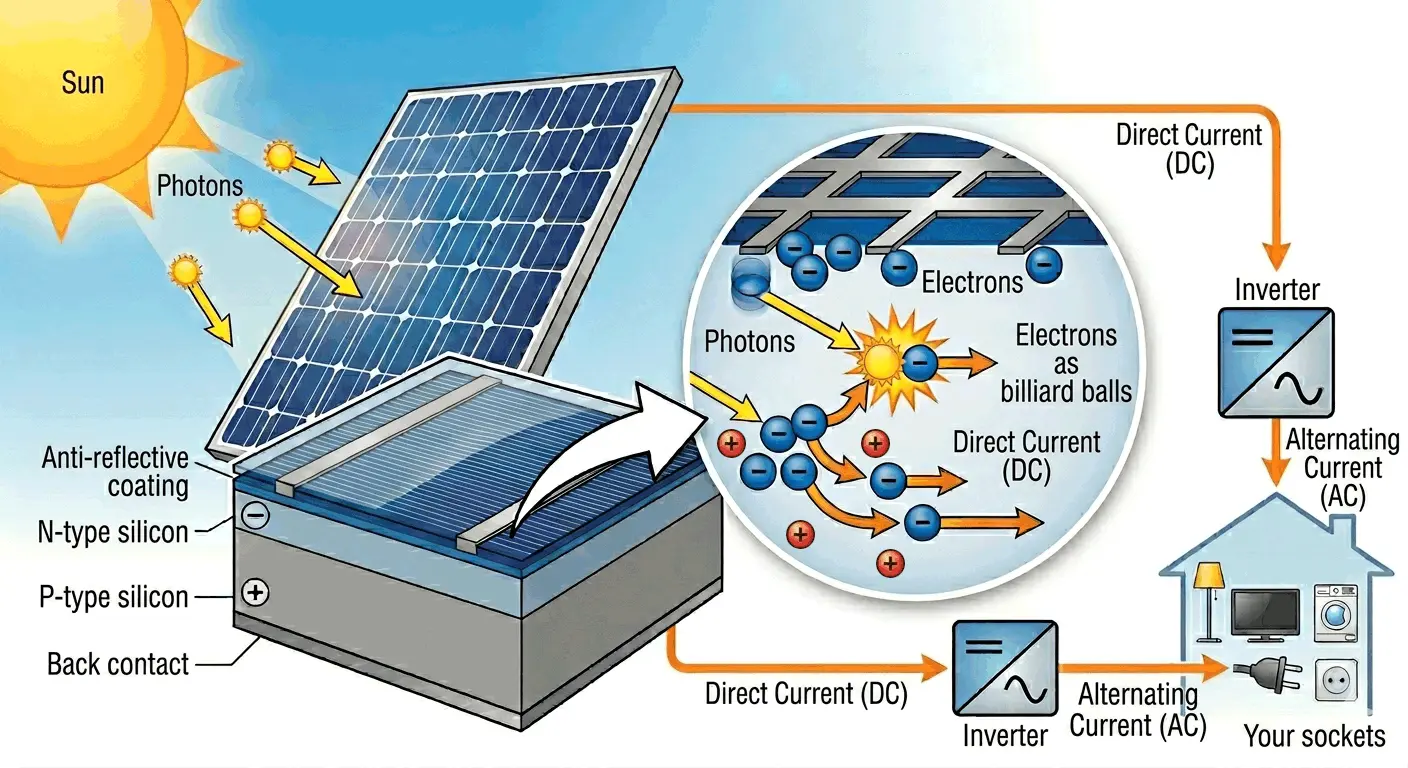
At the heart of each panel, there are silicon cells. When light particles (photons) hit the cells, they act like billiard balls, colliding with the electrons present in the silicon.
This shock frees up the electrons, which start to circulate. This orderly movement of the electrons is what creates a direct electric current. So that you can use this current in your house, a little box known as an inverter transforms it into an alternating current, the same type that supplies your plug sockets.
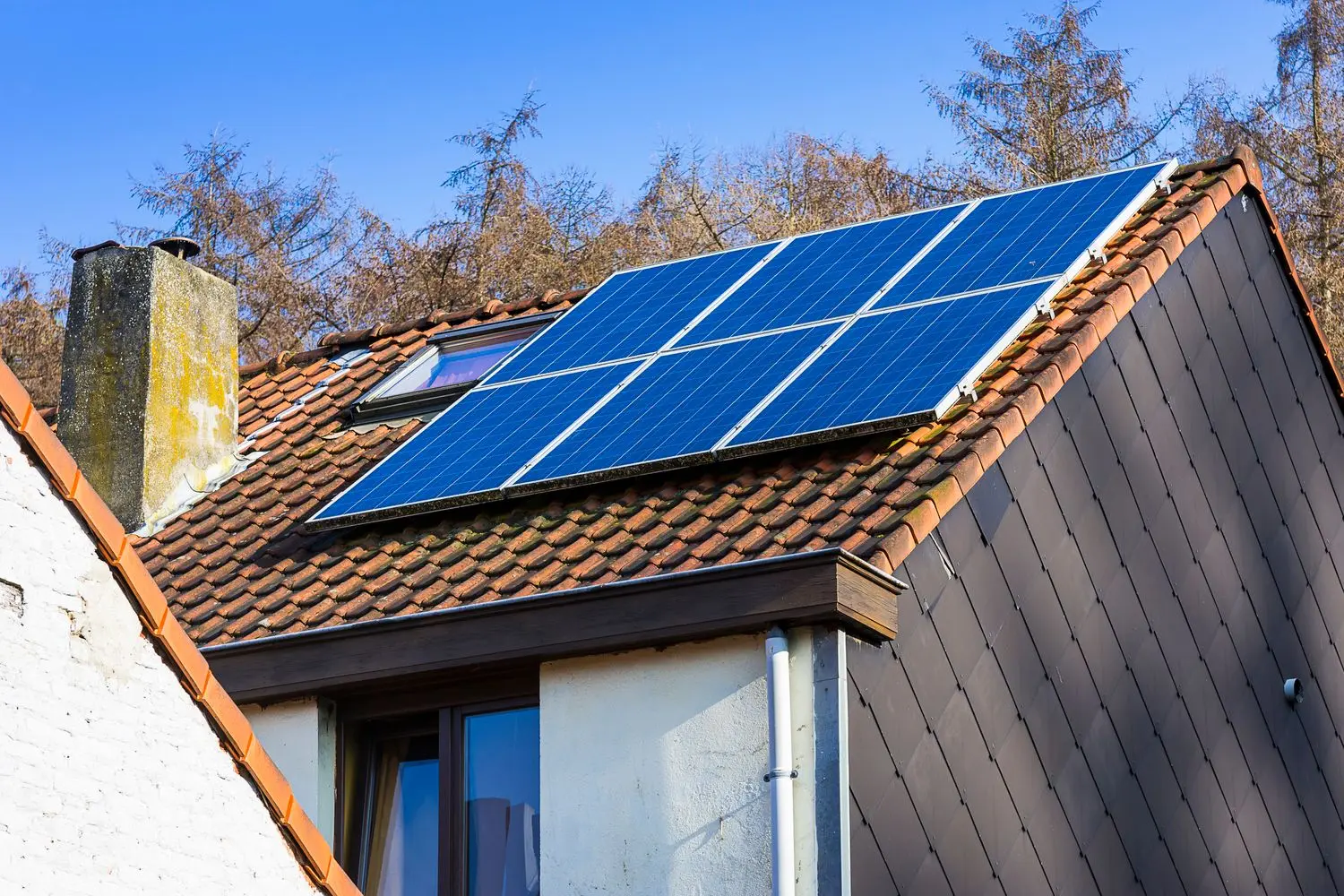
When do my solar panels produce the most?
Do your panels really produce more in summer? From rain and snow to heatwaves, discover the real impact on your system.
The 4 stages of the process
- Impact: Photons from the sunlight collide with the electrons in the silicon, freeing them up.
- Departure: The electrons are pushed into your cables. This flow forms a direct current (DC).
- Conversion: As your appliances use an alternating current (AC), the inverter transforms the flow to make it compatible with your home.
- Returning to the fold: Once their energy has been delivered to your appliances, the electrons continue on their way through the circuit to complete the circle. The panel is never emptied out, but acts like a pump that maintains a constant pressure in your cables as long as the sun is shining.
Why silicon?
Silicon is what's known as a "semiconductor". It's not quite an insulator, but nor is it quite a conductor. It's this ambivalent nature that allows us to control the flow of electricity. One small eco-friendly bonus: Silicon is extracted from sand. It's one of the most abundant elements on Earth!
Internal architecture
In their quest to improve yields, engineers are now no longer content with just a single silicon plate. Instead, they're creating high-tech "sandwiches":
- TOPCon: An ultra-thin layer of oxide (a "tunnel") is added to allow the electrons to pass through without dispersing. It's one of the most competitive options available today.
- Heterojunction (HJT): Here, the silicon is surrounded by fine layers of amorphous silicon. This allows the panels to generate electricity even when the light is diffused, which is a major advantage with our somewhat temperamental skies.
- ABC (All-Back Contact): All electrical connections are placed on the rear side. As a result, the front side has an all-black, aesthetic appearance, and captures 100% of the light without being shaded by silver wires.
- Perovskite: This is the great promise of modern laboratories. It's a material you can "print" onto silicon. By combining the two materials, (known as Tandem cells), you can create a panel that's able to absorb a larger range of colours across the solar spectrum. It's a bit like upgrading your panel from seeing in black and white to one that can see in ultra-HD.
Capturing sun from below
Did you know that some panels, known as bifacial panels, can generate electricity on the rear side too? They capture light that is reflected off your roof. If you have a surface that's covered in light-coloured gravel or grey roofing, you could increase your production by 8 to 15%!
What should you choose today?
If you're considering a project in 2026, the answer depends on your roof:
- For the best value for money: TOPCon (N-type technology) is the current standard.
- To make the most of a smaller surface area: HJT or ABC offer better yields per m².
- To optimise your consumption: If the electricity generation is too concentrated around the midday sun, you could offset this with a battery, if your budget allows.
- Opt for east- and west-facing panels if you want to line up with your need for energy in the morning and at night. The overall annual yield will be slightly lower than with fully south-facing panels, but you could spread your production more evenly over a day, and use more of the electricity yourself.