
Fluorescent tubes are no longer being manufactured and are making way for LED. Good news: LED lighting uses up to two-thirds less energy and lasts five times longer. But should you opt for LED tubes in your existing fixtures or go for new LED panels?
Still have fluorescent tubes in your basement, garage or storage room? You probably know the problem: that flickering and clicking when switching on, especially in cold weather.
The fluorescent tubes we used for decades are no longer being made. Like incandescent bulbs, they've disappeared from the shops. Fortunately, switching to LED is easier than you might think – and you'll be rid of that annoying start-up behaviour straight away.
Benefits of LED lighting
Why should you replace your old fluorescent tube with an LED tube? Here are the key differences:
| Fluorescent tube | LED tube | |
|---|---|---|
| Energy consumption | Higher (starter uses energy) | Up to 65% lower |
| Lifespan | ~10,000 burning hours | ~50,000 burning hours |
| Start-up time | Flickers when switching on | Instant full light |
| Light colour | Usually cool/clinical | Choice from warm to cool |
| Cold rooms | Works less well | Excellent |
| Heat (>45°C) | No problem | Lifespan decreases |
The higher purchase price of LED tubes is often recouped within a year through lower energy consumption – especially if your basement or garage lighting is regularly in use.
LED tubes or LED panels?
When replacing, you have two main options: LED tubes in your existing fixtures, or new LED panels. Both have their pros and cons.
| Ledbuis | Ledpaneel | |
|---|---|---|
| Principle | Replaces fluorescent tube in existing fixture | Entirely new lighting element |
| Cost | Low (tube + LED starter only) | Higher (new fixture + installation) |
| Light distribution | Directed downwards | Even and diffused |
| Dimmable | Sometimes | Often |
| Ideal for | Basement, garage, storage | Renovation, living spaces, office |
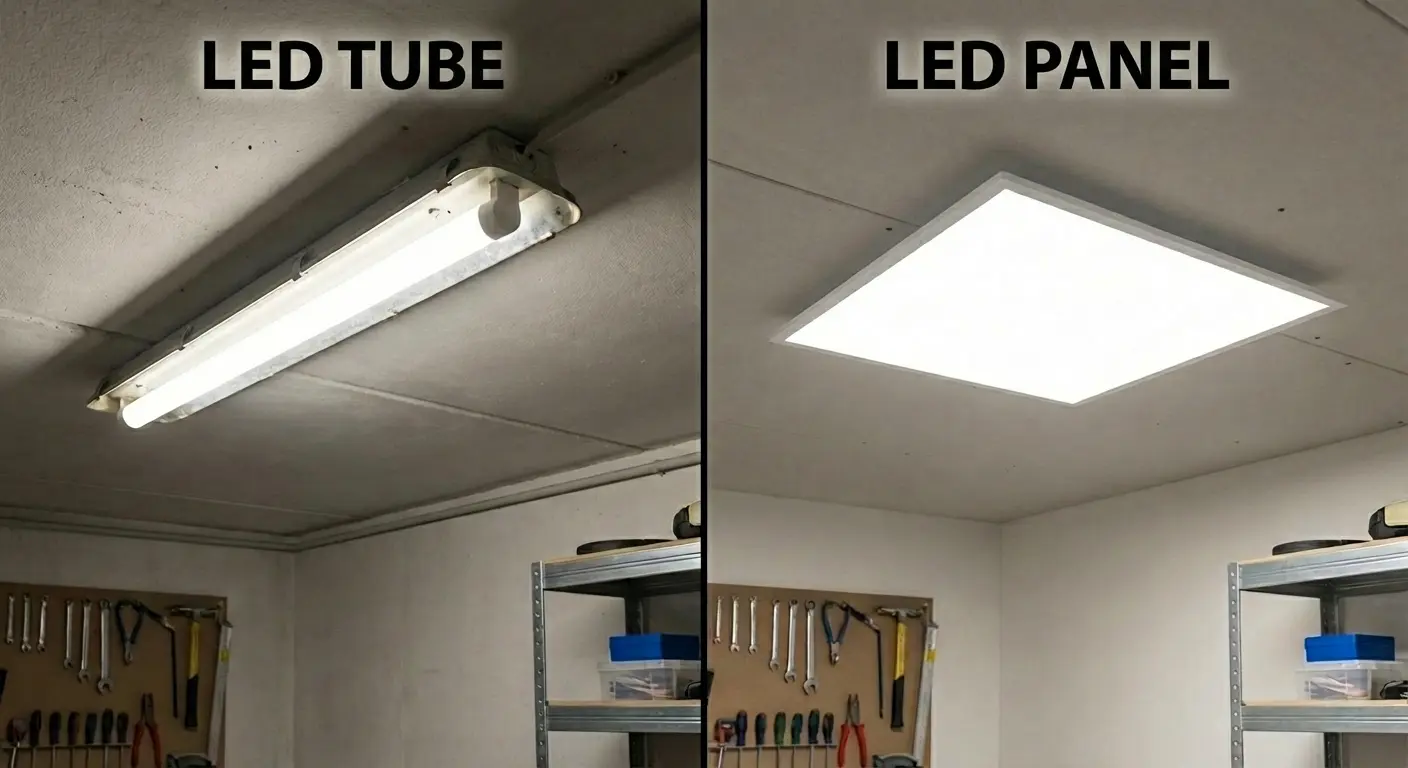
Rule of thumb: Quick and cheap replacement? Choose LED tubes. Thorough renovation? Go for LED panels.
Installing LED tubes
Installing an LED tube in your existing fluorescent fixture is often simpler than you'd think, but the approach depends on your fixture.
What type of fixture do you have?
Look at your current fluorescent fixture.
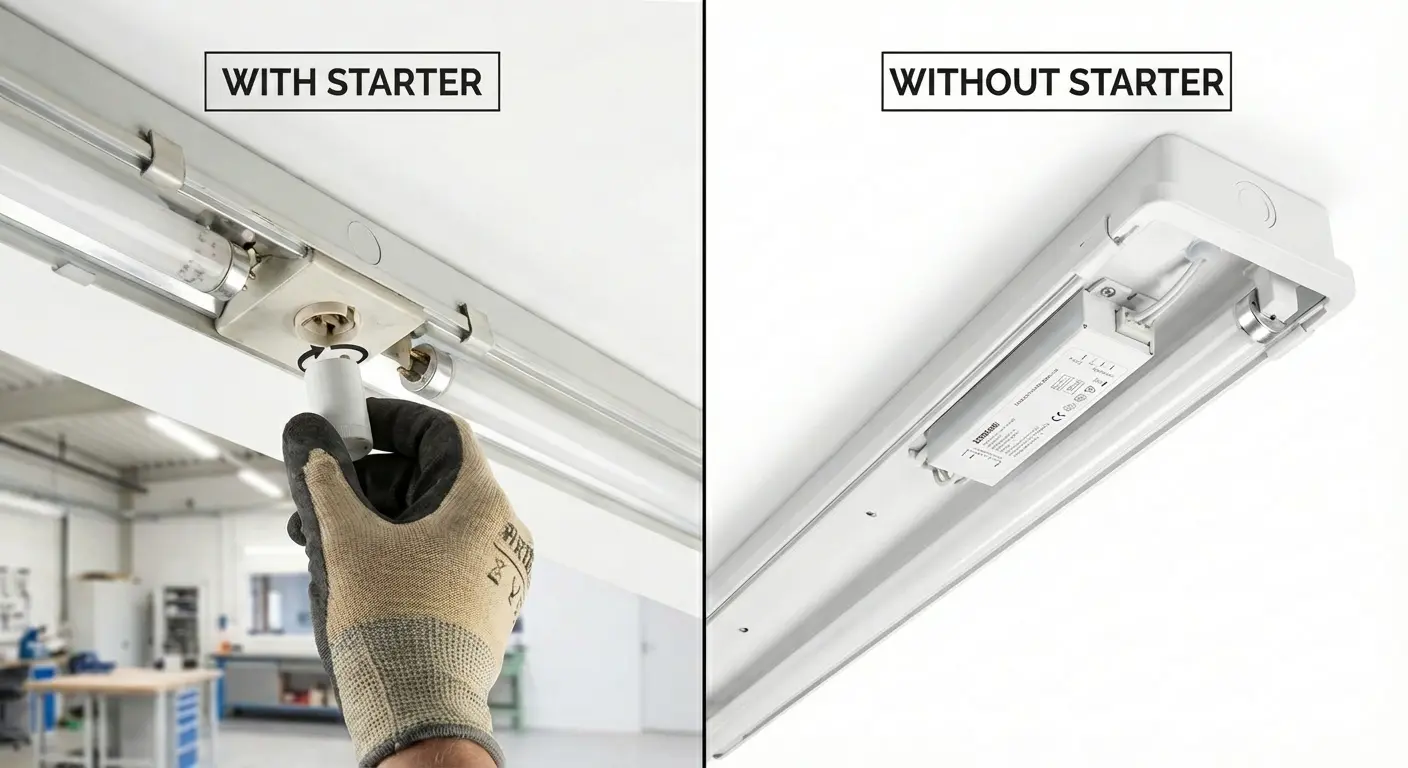
- Is there a starter – that small white or grey cylinder you can twist and remove? Then you have a conventional ballast.
- Does your fluorescent tube switch on directly without a starter? Then it's electronic.
| Type | Recognition | What to do |
|---|---|---|
| Conventional (KVG/VVG) | Starter present | Replace starter with supplied LED starter, ballast stays in place |
| Electronic (EVG) | No starter, switches on directly | Choose LED tube suitable for EVG, or remove EVG and connect directly |
Note: some LED tubes require the ballast to be removed or bypassed. This is a minor wiring adjustment. Not complicated, but call in an electrician if you're not comfortable with this type of work.
What to check before buying?
Before purchasing, check:
- Length: 60, 120 or 150 cm
- Type and fitting:
- T8 (26 mm diameter, G13 fitting – standard for most fixtures)
- T5 (16 mm diameter, G5 fitting – thinner, more modern)
- or more rarely T9
- Compatibility: KVG, EVG or both (stated on packaging)
Not sure? Take a photo of your fixture and bring the old tube to the shop.
Installing LED panels
LED panels require a different approach: you replace the entire fixture.
H3: Recessed or surface-mounted panel?
| Type | When to choose |
|---|---|
| Recessed panel | For suspended ceiling or modular ceiling – the panel sits flush with the ceiling |
| Surface-mounted panel | For concrete or wooden ceiling – the panel is visibly mounted against the ceiling |
Standard sizes are:
- 60x60 cm (common in offices)
- 30x120 cm (comparable to a fluorescent fixture)
Connecting your LED panel
LED panels operate on 230V and require an external driver (often supplied). The driver converts mains voltage to the correct voltage for the panel.
For recessed panels, the driver is usually separate and hidden above the ceiling. For surface-mounted panels, the driver is often integrated into the housing.
Tip: Choose a panel with a plug-and-play connection if you don't want to call in an electrician. Otherwise, a fixed connection by a professional is recommended.
Tutorial: LED tube installation
Watch this short video showing step by step how to convert a fluorescent fixture for LED tubes, including removing or bypassing the ballast for direct 230V connection.
How to install a LED tube ?
Frequently Asked Questions
Frequently Asked Questions
Can I keep my old fluorescent fixtures?
Yes, in most cases. With a suitable LED tube, you only replace the tube itself and keep the fixture. Just check that your fixture is compatible with the type of LED tube you choose – see the packaging for KVG or EVG compatibility.
How much can I save with LED?
A LED tube uses approximately 65% less energy than a fluorescent tube at the same light output. With regular use, you'll often recoup the extra cost within a year through your electricity bill.
What is the LED starter that's included?
The LED starter closes the circuit without doing anything else – it replaces the old fluorescent starter in fixtures with a conventional ballast. Without this LED starter, the LED tube won't work in that type of fixture.
Which light colour should I choose?
For basements, garages and workspaces, neutral white (4000K) is a good choice: bright enough to work by, without being too cold. For living spaces, opt for warm white (2700-3000K) for a cosier atmosphere.
Can I install an LED tube myself?
For a simple replacement – swapping the starter, fitting the tube – a handy DIYer can do this themselves. Does the wiring need modifying because the ballast must be removed? Then call in an electrician. Safety first.