
Want to replace an old incandescent, halogen or energy-saving bulb? Nowadays, LED lighting is the obvious choice. LED bulbs are energy efficient, long-lasting and available in all brightness levels and colours.
Why LED lighting?
Lighting accounts for approximately 16% of the total electricity consumption in an average home. So there is a clear opportunity to save here!
Every little bit helps. By replacing your old bulbs with LED bulbs, you are taking a concrete first step towards a more sustainable world. LED bulbs:
- consume up to 80% less energy;
- last 20,000 to 40,000 hours;
- provide instant light;
- barely get warm.
That is why they are now the logical choice.
Welke ledlamp als vervanging?
The comparison table below shows which LED bulb you can use to replace your old bulb to maintain the same amount of light.
| Incandescent bulb1 | Halogen bulb2 | Energy-saving bulb | LED bulb |
|---|---|---|---|
| 100 watts | 70 watts | 23 watts | 18 watts |
| 75 watts | 55 watts | 18 watts | 14 watts |
| 60 watts | 45 watts | 13 watts | 9 watts |
| 40 watts | 30 watts | 9 watts | 6 watts |
| 25 watts | 17 watts | 5 watts | 3 watts |
| 15 watts | 11 watts | 4 watts | <2 watts |
(1) Incandescent light bulbs have been phased out since 1 September 2012.
(2) Halogen bulbs have been phased out since 1 September 2018.
The light output of LED bulbs improves year after year. Use the comparison table above as a guideline, not as an absolute benchmark. For example, where 7 watts are needed today for a certain light intensity, 5 or even 2 watts may suffice in a few years' time.
A handy rule of thumb
Simply divide the wattage of your old bulb by 6 to 8 to find the right LED equivalent. While powerful LED bulbs lose some relative efficiency, small bulbs maintain excellent performance even at low power.
Think in terms of lumens
Not sure which LED bulb corresponds to your old bulb? Then look at the number of lumens, which is clearly stated on the packaging. This will help you choose the right light level for every room, from the kitchen to your home office.
For the 'oldies' among us, here is a brief comparison of the light intensity in lumens versus the power of the old incandescent bulbs.
| Incandescent bulb | LED bulb | Light intensity |
|---|---|---|
| 100 watts | 18 watts | 1,500 - 2,000 lumens |
| 75 watts | 14 watts | 1,100 - 1,400 lumens |
| 60 watts | 9 watts | 700 - 1,000 lumens |
| 40 watts | 6 watts | 400 - 600 lumens |
| 25 watts | 3 watts | 200 - 300 lumens |
| 15 watts* | <2 watts | 100 - 200 lumens |
(*) Lights for refrigerators or ovens with low light intensity.
Colour temperature
In addition to light intensity (number of lumens), colour temperature is also important. This allows you to determine exactly the atmosphere you want to create in each room.
Colour temperature is expressed in kelvin. The higher the value, the cooler and bluer the light. Lower values give warmer, yellower light.
To help you get started, below is a brief overview of the most common types of light and their corresponding colour temperatures:
| Cool white | 5,500 to 6,000 kelvins |
|---|---|
| Neutral white | 4,000 to 4,500 kelvins |
| Warm white | 2,500 to 3,000 kelvins |
| White with a yellow tint | +/- 2,200 kelvins |
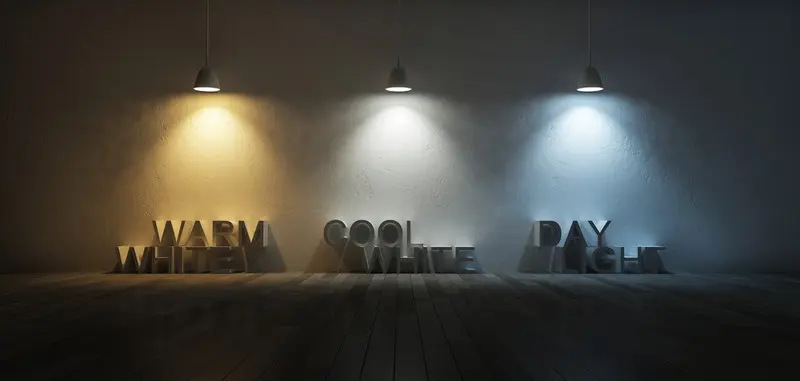
Which colour temperature shall I choose for my LED light?
Get rid of those energy-saving bulbs!
Energy-saving light bulbs (compact fluorescent lamps) were the energy-efficient alternative to incandescent bulbs for many years. However, European regulations are phasing them out gradually. Here's why:
- They contain a small amount of mercury.
- They are less energy-efficient than LEDs.
- They have a start-up time before they reach full brightness.
Most energy-saving light bulbs have been banned since 2023. They are still available in limited quantities in some shops, but they are no longer actively produced.
For those who want to live sustainably and save energy, LED bulbs are the best choice today.
Replace bulbs before they blow?
We often wonder if it makes sense to replace a bulb that’s still working. Is it truly eco-friendly or just a waste of resources? Don't wait: replace your incandescent bulbs right now rather than waiting for them to pack up. They waste 95% of their energy as heat! With their much higher efficiency, LEDs pay off their manufacturing "eco-debt" in just a few months.