There is nothing more unpleasant than an unexpected power cut. Fortunately, the cause is often easy to determine. A few simple checks are all it takes to know what to do.
The entire neighbourhood without power?
A power cut can be a widespread problem, but it can also occur only in your home. If you notice that the whole neighbourhood is without power, the problem is with the distribution network.
In this case, check first whether the outage is mentioned on your network operator's website. If you live in Brussels, this is Sibelga. If this is not the case, do not hesitate to contact them to report the outage.
Just your home without power?
If the problem is only affecting your home, the power cut is coming from your installation. Take the following steps to locate the problem. In many cases, you will probably be able to solve the problem yourself.
If nothing in the house is working, it means that a main circuit breaker has been tripped. This may be due to a faulty appliance or too many appliances being used at the same time.
Unplug the appliance(s) in question and check the safety device in your electrical panel (after the meter).
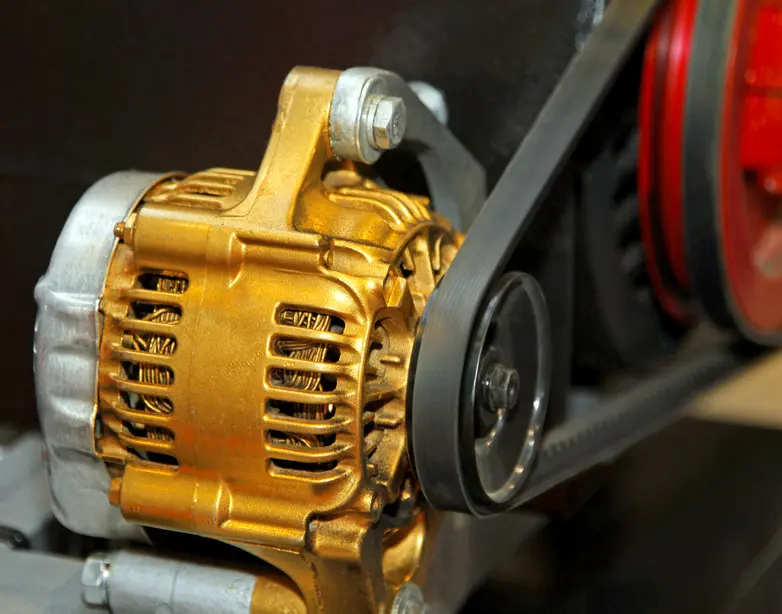
Can I deal with power cuts using a generator or a battery?
A generator or a battery seems ideal for dealing with power cuts. But is it really a good choice?
1. Check the main residual current device (RDC)
The main residual current device is also commonly used as a main switch. It often has a larger switch with a "test" button. If it is the "main" residual current device, it should be marked "300 mA" (milliamps).
- The sign: The large switch is down (off position).
- What to do: Unplug the appliance suspected of causing the fault, then simply flip the switch upwards.
2. Check the main circuit breaker
If your RCD does not act as a main switch, you may have a separate main circuit breaker on your electrical panel, in addition to an RCD.
- The sign: The switch is down (off position) or in an intermediate position, while all the others are up.
- What to do: Unplug the appliance suspected of causing the fault, then simply flip the switch back up.
3. Special case: cartridge fuses
Older electrical panels may still have fuses instead of a main circuit breaker. These are not switches: they physically blow and must be replaced. How can you tell if a fuse has blown?
- The indicator (tab): Some fuses have a small coloured tab (often red) on one side. If the fuse has blown, the tab is ejected or falls out.
- The filament (glass): If the fuse body is made of transparent glass, look at the metal wire inside. If it is broken or there is a black burn mark on the glass, it is dead.
- Visual test (ceramic): On opaque models without a disc, it is impossible to see if it is blown with the naked eye.
Do you still have fuses? Be careful!
If you still have fuses, it is highly likely that your panel does not have a residual current device either.
In this case, your installation is very dangerous. If there is a current "leak" on a faulty appliance (e.g. washing machine), the casing will remain live and you risk electrocution if you touch it. The RCD is the only device that can save your life.
Do not wait for an official inspection. Having a 300 mA residual current device added to your fuse box is a quick job for an electrician. It is the most cost-effective investment you can make for your safety.
4. Still no power?
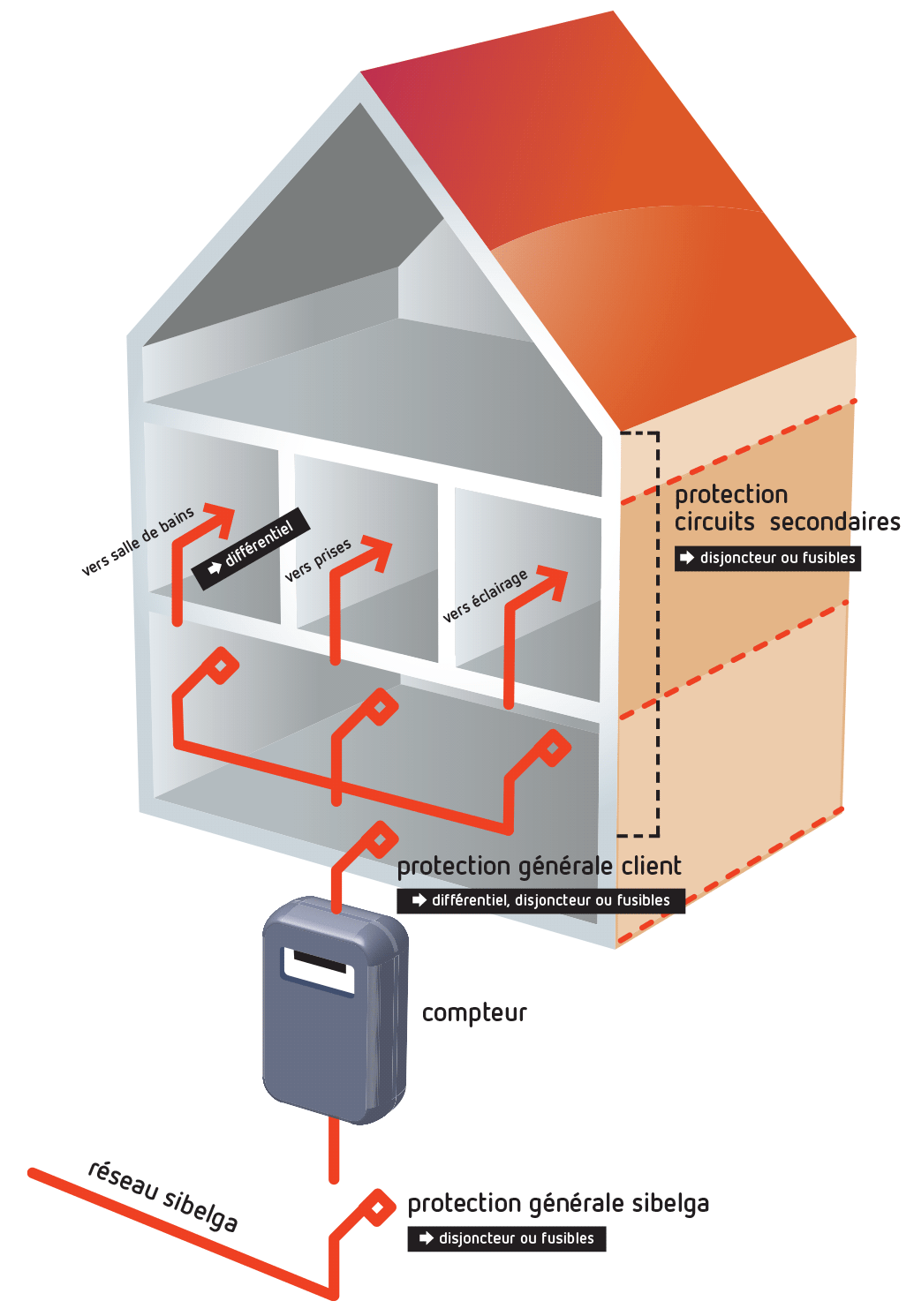
Also check the protection located before the meter, at the connection box.
- If you see a circuit breaker, check that it is properly engaged (raised).
- If you have an older installation, you may still have fuses and they may have blown. Contact your network operator (e.g. Sibelga in Brussels). They will come and replace them.
No power in certain areas?
If the power cut only affects one floor or one appliance, the problem is probably with a secondary circuit, which is also protected by a fuse, an automatic circuit breaker or a residual current device.
Proceed in the same way. You should normally have a circuit in your electrical panel for:
- lighting (one per floor)
- specific bathroom lighting
- sockets (maximum 8 per circuit)
- bathroom sockets
- the dishwasher
- washing machine
- hot water
- the boiler
- electric hobs
- ...
The different circuit breakers
An overload or short circuit can damage your electrical system and cause a fire. This is why it is protected by "circuit breakers" (fuses, automatic circuit breakers or residual current devices).
These devices react to excessive current caused by the simultaneous use of too many appliances, a faulty appliance or a fault in your installation.
- A fuse contains a metal wire that melts when the current exceeds a certain value. Has it fulfilled its role of protecting the installation? If so, you must replace it with a new fuse.
- An automatic circuit breaker, on the other hand, can be used several times, as you can reset it each time.
- Unlike a standard circuit breaker (which protects equipment from short circuits), an residual current devices (RCD) protects people. It cuts off the power as soon as a current leak is detected. RCDs have been mandatory since 1981 for all domestic electrical installations.
Diagram of an electrical installation
This handy diagram explains how your electrical installation works.