
Whether in summer or winter, there are plenty of occasions to use an extension lead for Christmas lights, a space heater or a power tool. It is very convenient, but your safety must always come first.
Check before use
Has your extension lead not been used in a long time? Why not start with a safety check-up?
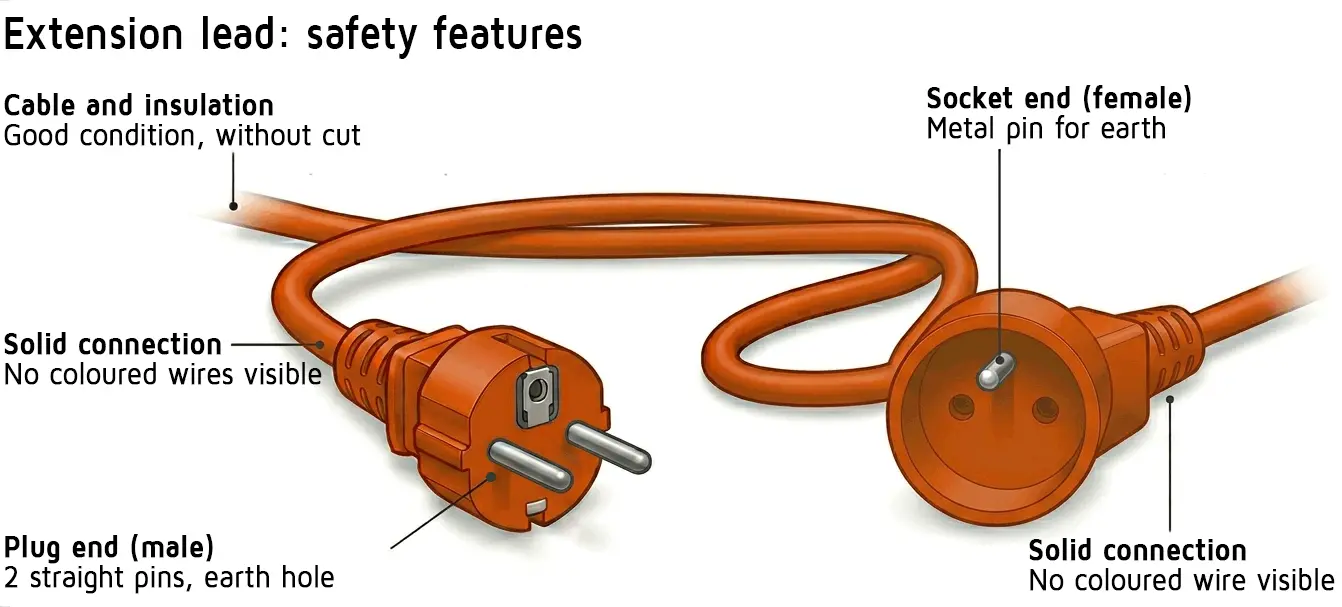
- Cable insulation: Is it in a good condition all the way along, without any cuts or deformities?
- Plug end (male): Are the 2 pins completely straight, stable and not showing any signs of burns? It must have a hole (for the earth pin that comes out of the wall) or side contacts (Schuko system).
- Socket end (female): This must have a metal pin sticking out (earth connection) to plug into your appliance.
- Fixings: Are the plug and the socket fixed securely to the cable? No coloured wires should be visible where the two are connected.
- Danger signals: If you hear a crackling noise, can smell burning or if the plastic is hot to touch, unplug it immediately.
What if there's no earth pin?
Extension leads without an earth wire (known as "Class II", often with a flat plug) are available for double-insulated appliances that don't need it, such as small lamps. If the appliance you want to plug in has a male plug with a hole for the earth pin ("Class I"), the extension lead must be earthed at both ends (a hole on the male end and a pin on the female end) to ensure you're protected in the event of an electrical fault.
Connecting appliances
Want to plug in a tool or a grill? Pay attention to the maximum power. Check that the accumulated power of all connected appliances does not exceed the maximum rated power of the adaptor and the cable (e.g. 2,300 W).
- If the extension lead is rolled up or stored on a reel: Unroll it completely before switching it on to prevent the cable from heating up.
- If you need to plug in several appliances: Don't use rigid three-way adaptors (which are unstable and unsafe). Instead, choose a multi-way adaptor with switches and protection against overvoltage.
- Don't make a chain: Never plug several extension leads or multi-way adaptors into each other to increase the length. Each additional connection creates a potential heating point.
- High-power appliances: For appliances that generate a lot of heat for a long period of time (portable radiators, ovens, irons, etc.), always plug these directly into a wall socket. If you absolutely have to use an extension lead, make sure it is thick enough (2.5 mm²) and is the only thing plugged into the wall socket.
- Mobile appliances (lawnmower, tools): Using an extension lead is unavoidable here. Just make sure you're using a cable that is thick enough for the power of the tool (often 16 A for a lawnmower).
How can I protect my electrical appliances from voltage fluctuations?
In the event of a power surge or undervoltage in the electrical network, your appliances could break down. Fortunately, a few simple steps are all it takes to prevent this from happening.
What is the maximum power of your extension lead?
The maximum power depends on the cross-section of the cable:
- 1.5-mm² cable: limited to 10 amps, or 2,300 Watts.
- 2.5-mm² cable: allows 16 amps, or 3,680 Watts.
In Belgium, the maximum power for a multi-way adaptor or high-quality extension lead is often 3,680 Watts (16 A x 230 V), but not all extension leads will necessarily have this capacity. Always check the label.
Outdoor use
For outdoor use or damp rooms, opt for rubber cables and a socket equipped with an IP44 or IP65 protective cover. The IP44 standard guarantees protection against splashing water (suitable for covered outdoor areas and bathrooms), while the IP65 standard offers protection against water jets (suitable for exposed outdoor spaces).
A garden extension lead is often made of rubber or neoprene, while an extension lead for indoor use is usually made of hard plastic (PVC). Rubber is essential for outdoor as it is waterproof and flexible.
- For garden lighting, connecting an extension lead for an evening is not a problem. But under no circumstances must it be left in place. Fixed garden lighting is subject to specific rules. Electric extension leads are only a temporary solution. For fixed uses, a more permanent solution should be sought.
- To supply Christmas lights which will be in use for several weeks, use equipment that is intended for outdoor use with a suitable IP rating.
- Beware of vehicles: Ideally, always place any cables away from where cars will be driving. Place a plank either side of the cable which is slightly thicker than the cable itself if vehicles absolutely have to drive over it. You must never leave a cable unprotected because if the wires inside are crushed, this can create an invisible short circuit under the insulation.