It isn't always easy to make sense of the figures flashing on your meter or the details on your bill. However, understanding how your consumption is calculated is the first step towards better managing your energy costs. Here is how to get a clearer picture.
From traditional to smart meters
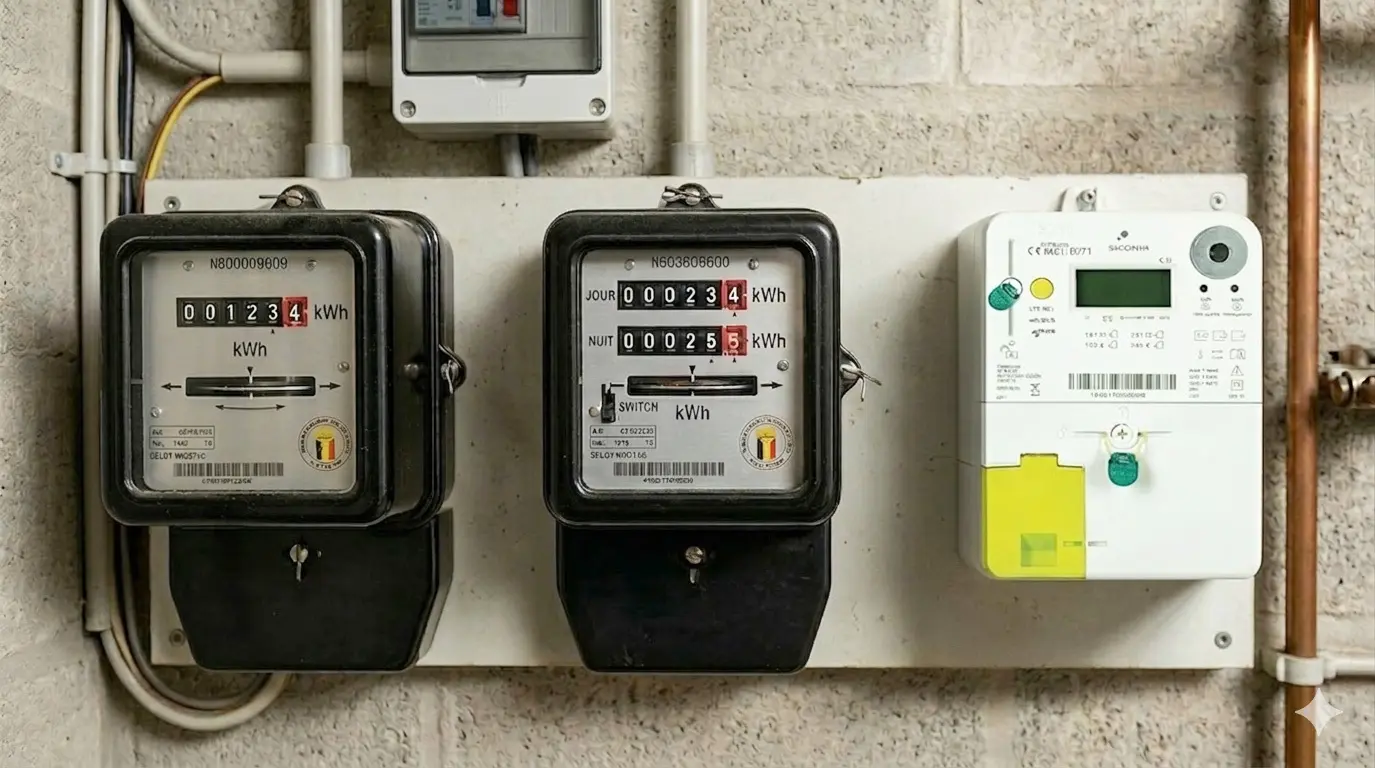
In Brussels and Wallonia, many households still use traditional electromechanical meters, recognisable by their rotating discs.
But the energy landscape is evolving: more and more homes are now equipped with smart meters. These make administrative procedures much easier and allow for far more detailed tracking of your consumption habits.
What type of meter do you have?
There are several configurations depending on your installation and your contract:
- Single-rate meter: This has only one display. You therefore only have one reading to submit for your entire consumption.
- Dual-rate meter: This features 2 separate displays. You will need to take 2 different readings: one for peak hours and one for off-peak hours.
- Night-only meter: This has a separate display, often linked to electric storage heating (this type of installation is becoming rare).
- Smart meter: Here, there are no more mechanical dials, but a single digital display. You have to scroll through the menus to read the different readings identified by display codes (usually 1.8.1 for peak hours and 1.8.2 for off-peak hours).
Mechanical yesterday, digital today
On an old meter, the current passes through 2 coils, creating a magnetic field that turns a wheel. Today, smart meters have no moving parts at all: everything is electronic!
The calculation: a simple subtraction
Once these readings have been taken from your dials (or digital screen), calculating your consumption becomes child's play. Your grid operator (Sibelga, Fluvius, ORES, etc.) takes care of it. The principle is simple: the old reading is subtracted from the new one.
Example with a single-rate meter:
- Last year’s reading: 12,500 kWh
- Today’s reading: 15,200 kWh
- Annual consumption: 15,200 - 12,500 = 2,700 kWh
If you have a dual-rate meter, the operation is performed twice: once for the "peak hours" reading and once for the "off-peak hours" reading.
What is a kWh?
A kilowatt-hour (kWh) corresponds to the energy consumed by a 1,000-watt (1 kW) appliance used for one hour. For example, using a 2,000 W iron for 30 minutes will consume exactly 1 kWh.
Don’t confuse your meter with your rate!
This is an important distinction: having a dual-display meter does not automatically mean you benefit from a dual rate. It depends on the contract you have signed with your energy supplier. This is also true for smart meters.
Furthermore, dual tariffs are evolving with the energy transition. Traditionally, "off-peak hours" were at night and during weekends, but grid operators are now adapting these time slots to better align with renewable energy production. Since 1 January 2026, Wallonia has led the way with a radical change, while Brussels is planning adaptations in the near future.
Off-peak time slots by region (as of April 2026):
| Region | Off-peak hours (reduced rate) | Notes |
|---|---|---|
| Brussels | 22:00 - 07:00 + Weekends | Traditional system (changing soon) |
| Wallonie | 11:00 - 17:00 and 22:00 - 07:00 | New system since 2026 |
| Flandre | Capacity rate | Based on peak demand (kW)* |
* Flanders no longer uses time slots to calculate distribution costs, but many suppliers still offer contracts with a cheaper kWh price at night (energy price).
What if I produce my own energy?
If you have solar panels, the basic principle remains the same. The big difference is that you receive a compensation for the kWh that you don’t use instantly and instead inject back into the grid.
If you have a smart meter, you can check exactly how much electricity you have injected by looking at code 2.8.0.
The benefits of going digital
A smart meter is more than just a measuring tool; it’s a real asset to help you manage your energy more effectively.
- No more manual readings: If remote reading is activated, your readings are transmitted automatically.
- Consumption tracking: You can use the My Sibelga App to monitor your consumption day by day for free.
- New possibilities: Smart meters provide access to new services, such as a dynamic rate or personalised energy advices.